

State of Emergency Preparedness Gives Community Safety Tips
mrandolphadvance@gmail.com
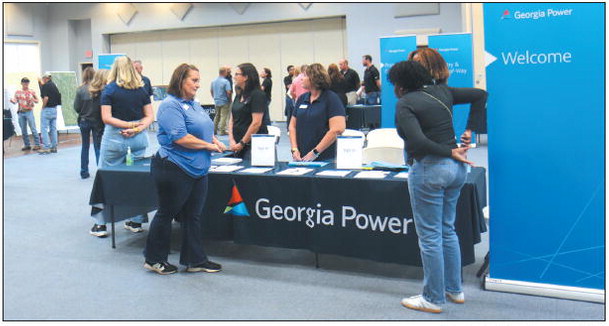
During the Greater Vidalia Chamber State of Emergency Preparedness event on Thursday, April 2, Georgia Bureau of Investigation Special Agent Michael Kight and Toombs County Emergency Management Agency (EMA) Deputy Director C.J. Worden spoke to community members about protecting and preparing their businesses and themselves for emergencies.
Special Agent Kight has over 11 years of law enforcement experience, and is currently working in the Georgia Bureau of Investigation Cyber Crime Unit, which is headquartered in Augusta and manned by four special agents, an assistant agent in charge, and a special agent in charge, who cover cyber crime committed across the entire state. He specializes in cyber crime investigations and cryptocurrency-related fraud.
“When cases get to us, be patient. Sometimes, it does take a minute because there’s only four of us that handle it,” he told the audience. “Also housed in the Cyber Crime Center is our Child Exploitation Unit, the Secret Service, the Attorney General’s office, and some digital forensic investigators. One thing I do like to mention, with us as State Agents at the Cyber Crime Center – we are a whole task force of the Secret Service and also the Federal Bureau of Investigation Fraud Task Force.”
Kight continued, “So what we do, we handle a lot of cyber crime that involves financial loss, attaching to businesses and company systems, and it is happening on a daily basis. So I'm so glad to talk to you guys because it's not just the public safety that can be affected, but it's also the communities and the businesses.”
According to Federal Bureau of Investigation, Georgia is one of the ten states in the nation with the most cyber crime. Yet, even with this statistic, Kight said that the reported amount of money stolen through cyber crime in Georgia is relatively low because often, individuals and businesses do not report these attacks or losses. “When you don’t report, we cannot help you. We cannot save your business. We cannot get your money back. You guys need to report this,” Kight emphasized.
He said that cyber crime is not new, and has been occurring for decades, but only gets more difficult to fight with the advancement of technology. “For the most part, in most businesses, what we are seeing [cyber criminals get information from] is emails. It’s very, very common,” Kight remarked. “Same thing of how these scammers are getting your information. Has anybody shopped a Kroger or gas station? So, you guys sign up with your phone number. You sign up for emails to get the rewards. Even Kohl's, they have different stuff. What these companies are doing, when you basically type your phone number in, you are agreeing to their terms and conditions. And you know as well as I do, nobody's reading this. You automatically agree that they can sell your information. They can sell your phone number. That's probably why you're getting a lot of telemarketer calls. Because, and I am guilty of it. I did it before I didn't know.”
Kight explained that wire transfer fraud was also a common way that cybercriminals stole information and money, as he explained that a lot of times, this fraud originates in emails. “The majority of us email. I email. People do it all the time paying invoices. That’s what we do every day,” he said.
He continued, “I want to mention that recovery is rare. Criminals gain access to your legitimate email. So, what they’ll do – you’ve probably seen this – is change one thing. Then, they’re like, ‘Pay the invoice,’ and a lot of people just go ahead and send the money.” In his experiences, Kight shared that most individuals don’t even know they have been compromised until it is too late, as the criminal is usually in the system for an average of 11-16 days before they do anything. Before acting, the criminals simply watch your activities like suveillance to see who is sending invoices and being paid so that they may determine who to pretend to be.
Once this money is sent, it is very rarely recovered, so Kight encouraged individuals to avoid posting about receiving grants or large amounts of money until after the money was no longer vulnerable to being stolen. He also told the audience to call their local bank or office – not the number listed on an invoice – if they received an email requesting payment or information that seemed suspicious.
He recalled when the Georgia State Patrol was hit with ransomware in 2016 to explain how detrimental this crime may be. “A lot of times, it stems from a phishing email. What happens is the bad guys send the email, then when you click on it, they lock your system down,” he remarked. “So, long story short, with the Georgia State Patrol, this occurred, and it locked the entire system down – no accident reports, no information, nothing.”
After locking the system down, these ransomware criminals then demand payment to get systems back online. “We always advise, and they always say this even in movies, don't pay the ransom. We always advise not to pay a ransom. However, if you guys do pay the ransom, let us know immediately so we can track it. That is the biggest thing. Most businesses and companies will not report this because a lot of times you have to let your stakeholders know. You have to let your community know, and nobody wants that out there. I get it, but we can't help you if this occurs,” he emphasized.
Kight shared that because the Georgia Bureau of Investigation is a task force member of the Federal Bureau of Investigation, they may track the variant that the ransomware is controlled by and may have a key for individuals to regain their system without paying the ransom. He explained that typically, ransomware cases can last one to two weeks, but he had seen some take a month to return online.
He concluded his address by encouraging citizens to not use bitcoin ATMs or cryptocurrency because many of these devices steal information and ultimately, money. He told everyone to be safe and vigilant when online and to contact the Georgia Bureau of Investigation Cyber Crime Center if they become a victim of any of these crimes.
C.J. Worden
Toombs County Deputy Emergency Management Agency Director C.J. Worden also spoke at the event, as he discussed methods of preparing for and addressing emergencies in the workplace.
He began by explaining that he may not know the ins and outs of everyone’s business or company, but he did have understanding on how business owners and leaders could approach emergency preparedness. “Has anyone ever heard the Mike Tyson quote about having a plan? Tyson says, ‘Everybody’s got a plan until they get punched in the mouth.’ That is remarkably accurate. What that tells us, though, is that it is not having a beautiful plan to put on the shelf that gets us where we need to go. It’s the process of getting there, and when we build that culture within our organizations, that’s how we get there,” he told the audience.
Worden emphasized that a major component to emergency preparedness in the workplace culture is communication. “Whenever a crisis does occur, I would tell you to look at clarity over a speech. For example, if this building is on fire and I’m the only one that sees it, I’m not going to talk about the thermodynamics of a fire and why it’s important to get out. I’m going to say, ‘Fire! Get out!’ Be clear and concise and to the point,” he said.
He challenged business owners to think how they would communicate with staff if disaster struck and phone and internet lines were down, just as they were after Hurricane Helene. “It may be that you have to go to the home. You might have a predetermined place to meet,” Worden added.
Worden stated that businesses should also get to know their employees because they never know what hidden talents people have, as he shared a story of someone he worked with at Georgia Emergency Management who was a talented drywaller that helped him when he needed it.
He summarized the things that businesses should consider when dealing with emergency events, as he emphasized the order should be “the process, the people, then the place,” as people should focus on the plan for emergencies, the people they must take care of, then their structures or locations.
Worden also spoke on hostile situations that may come through the business’s doors. “Think about early warning signs. Supervisors need to be aware and coworkers need to be aware of how they interact not only with the customers and the clients but also with each other. If somebody's having a bad day, it could be that they've got a lot of problems going on. It could be that they had a flat tire this morning. It could be that they're a victim of domestic violence. So there are a lot of things that can go into just making sure generally that somebody's had a better day or has a better day,” he explained.
Worden emphasized that understanding how to deescalate situations is crucial in the workplace, and encouraged citizens to take training on how to respond when in active shooter situations when available.
He concluded his address by emphasizing the importance of being prepared for anything that comes a business’s way – whether it be cybercrime, natural disasters, or hostile situations.

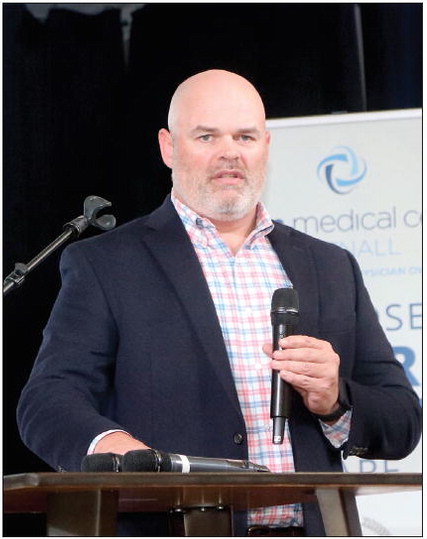
CYBERCRIME – Georgia Bureau of Investigation Special Agent Michael Kight gave the audience tips on protecting themselves from cybercrime.Photo by Makaylee Randolph