
Local Farmers Praying For Rain
mrandolphadvance@gmail.com
Local farmers, cattlemen, and agriculture professionals are praying for rain, as the area continues to bake in an extreme drought.
It has been over a month since the region has had significant rainfall, as the U.S. Drought Monitor recently announced that almost all of the entire area of Toombs, Montgomery, and Wheeler Counties is considered to be in a “D4 level” exceptional continued from page
drought, while Treutlen County is almost completely considered to be in a “D3 level” extreme drought.
According to Toombs County Extension Agent Jason Edenfield, so far this year, Toombs County has received 5.22 inches of rain, whereas by this point in 2025, 9.09 inches of rain had fallen, and in 2024, 17.16 inches of rain had fallen. “The modern average amount of rain we have received by mid-April is usually around 14 inches,” he remarked. “That is a big difference. In the last 7 days, we have had no rain. In the last 30 days, we have had no rain. In the last 60 days, we have had a little bit of rain, but it’s really been mostly dry since last September. We had a few showers in November and December, but we just haven’t received the rain we normally receive.”
Edenfield explained that this lack of rainfall was excellent for the individuals harvesting Vidalia Onions, but detrimental for those planting row crops and raising livestock. “This is ideal weather for harvesting onions – we couldn’t ask for better harvest weather,” he explained. “But this will definitely delay dry land cotton, peanuts, and corn that hasn’t already been planted. We have had almost no rainfall in 60 days – the last rainfall I have logged was on March 1617. We definitely need rain. I’m sure the Vidalia Onion guys want it to hold off a week so that they can finish harvesting, but our row crop and pasture guys desperately need it.” Vidalia Onion Farmer Aries Haygood agreed with Edenfield, as he explained that the weather had been wonderful for his work harvesting onions, but he understood that the drought was serious. Row Crop Farmer Chris Hopkins echoed these sentiments, as he shared that the weather had delayed his normal planting schedule. “We typically will start planting peanuts around April 20. Since it is so dry, we cannot get our strip to planting rigs to go in the ground and we surely do not want to put seed such as peanut seed that contain very high or content into the hot dry ground. Every day that we wait to start, planting puts us a day behind on the backside window for our planting opportunity,” he emphasized.
Hopkins continued, “We will need a significant rain to wet the ground deep enough to be able to plant any dry land crops. We are even skeptical about planting in the irrigated areas until we get a significant rain because we know it will be difficult to keep up with only irrigation. Also, the herbicides, which we utilize both pre-plant and during planting to give us weed control in our peanut and cotton crops, require rainfall to activate. If we plant into dry conditions, not only will we not have any emergence of our crop, but also we will not have any effective weed control because our herbicides will not be activated. Our planting window is basically the last two weeks of April and the month of May, and that is now upon us with planters parked waiting on rain.”
Montgomery County Extension Agent Lauren Stanley stated that conditions were relatively the same across the county line, and that the drought had even affected livestock farmers, as many cows had been sold from herds because farmers could not produce the hay needed to feed the animals and could not continue to keep buying large amounts of feed.
“Livestock producers are feeling immense pressure as grazing suffers under dry conditions- many producers are relying on supplemental nutrition for their animals, or downsizing herds to minimize the financial impacts of lost grazing and additional feed. Row crop producers are contending with dry, dusty fields during prime planting season. Some crops have already gone in the ground, mostly on irrigated fields, and those are totally reliant on that irrigation to survive and grow in these conditions. For crops going in on dryland fields, plantings may be delayed, and crops in the ground in dryland fields already will suffer the consequences of this drought until we get rainfall,” she added.
Stanley shared that she is concerned how the drought will further impact the agriculture industry financially if it continues, because of delayed planting and livestock owners buying hay and feed.
The drought was a hot topic of discussion during the annual Blessing of the Crops on Friday, April 17, as many community members and farmers spoke about the need for rain.
Vidalia Onion Festival Committee Member Jake Cleghorn, who also serves on the Georgia Bankers Association Agriculture Committee, spoke about a recent meeting the Committee had. During the meeting, the bankers went around the room to get an update on agriculture from throughout the state.
“When we got done with that meeting and with that update, it was one of the most depressing atmospheres I've ever been around professionally. Across the state, the agriculture industry is in a really, really dark time,” he said. “I've been to several conferences and spoken to people at several conferences lately about what that looks like from the financial side. You all know what it looks like from the agriculture side and the producer side, and we don't want to dance around that. It is a very trying time.”
He continued, “But my encouragement to us as a community, as a part of that farming community is it's real easy to see what's in front of your face, but there's always something to look forward to in life. And when times are really dark, like they are for a lot of people right now, we need to remember that. It's the little things that matter. But that doesn't mean that it's easy for these guys laying their head down and not knowing what they're going to do the next day on the financial side or the farm side. This drought just makes it that much worse.”
“So just know we're there. We're rooting you on. We're there for you. We're supporting you as a community. As community leaders, we understand you're going through a very difficult time. We’re going to remember that,” Cleghorn emphasized.
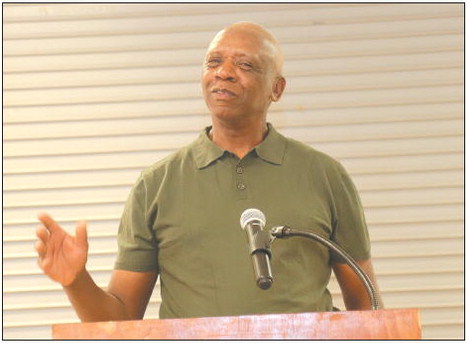
Farmer Sam Baker spoke about hope in the midst of crises, as he encouraged his fellow agriculture professionals to continue to pray and prepare for rain.
Baker – a third generation farmer and the pastor of a church in Montgomery County – began by explaining that he had faith that the agriculture community will make it through the drought, as he knows that his grandfather faced droughts and challenges of his own while farming.
“When we look at our world, we’ve got challenges. We’ve got crises. That’s basically what we have – we have crises globally [and] we have some crises nationally. You know, with the fuel prices being what they are – and fuel drives everything in the economy – it affects everything. And we even have crises locally, especially in our agriculture community,” he remarked. “So the question comes about, what I've been going to God and asking about is, we've been asking for rain.”
Baker continued, “I've been praying for rain. As I told one of my friends a few days ago, the rain is coming. It's coming. Now when it's coming, I don't know. But the Lord has assured me that it's going to rain. And it'll be in His time when we get it. But until then, we have to learn to function in the midst of the crises that we're dealing with.”
He went on to quote from the Bible, as he explained that in Matthew 7, Jesus compares the individuals who act on God’s teachings and those who ignore it, as the scriptures say the person who listens and obeys the teaching is like the wise man who built his house on the rock rather than the sand. The home built on the rock does not move during storm and crises, while the house built on the sand crumbles from the same pressure and trouble.
He added, “What this parable kind of teaches us is that the storm is not a sign that you built wrong, but it's proof that you did building at all. So when you're facing a crisis, it is proof that you are trying to do something that's worthwhile. If you're not trying to do anything, you won't ever have to worry about crisis and these kind of things. But it's when we're trying to go somewhere in life, trying to make life better, that the enemy will work against us.”
Baker discussed why he felt like God allowed crises, such as the drought, to happen in people’s lives, as he shared he had been praying for God to help him understand why this was happening. “He’s helped me in that regard because God allows crises to move purpose forward for our lives. Now, that may sound strange to us as farmers going through this, but God is allowing the crisis to happen because it's actually making me sharpen up on something. Making me look at things a little bit different. Making me begin to evaluate even closer than what I had been evaluating because crisis will bring about an adjustment in your life. And what I've come to learn about God is that with God, there is no crisis. With God, it's just another event. So, what we're calling a crisis, God is using that to help us [and] to help us along in our lives. So, if God allows a storm to come, we need to know that God is doing something behind the scenes. He's making us better,” he emphasized.
One purpose that Baker said he had learned God used crises for is to expose our foundation. “A storm really exposes what you built your life on. You see, in that parable that Jesus gave, He didn't give us the details of the story. But in my own mind, you know, the two houses were side by side. The two houses were built just alike. If you rode by them, you couldn't tell the difference because when people go looking for houses, guess what, they don't go looking for foundation. They look at what's on top – but what we really ought to be looking for is what it's built on,” he told the audience.
“So, when storms come in our lives, it is to reveal what we really built upon. Where is our faith really? What are we really trusting? For me, I have to realize that I'm not trusting my farm to make it. I'm trusting God to make it. My farm will never make it. Whenever I look at the numbers, when I look at this weather, I've got corn that's probably a foot and a half tall. We've watered it seven times already. The math tells me it isn’t going to make it. But guess what? I'm not worried about the math. God is going to make it work,” Baker remarked.
He reminded the audience that the agriculture community – and the community as a whole – is a resilient people when they focus their faith in the right place. “If we build our lives on the Lord, then whatever we face, we can overcome,” he shared. “If we put God in the right perspective, all of this other stud will take care of itself. And if it doesn’t work out as we plan, guess what? It wasn’t His plan. But as long as we are in Him, everything will be alright. Two things are going to stand, regardless of anything else: God’s promises and God’s Word.”
Baker ended the event by leading the attendees in prayer for rain, and reminding them that God always gives purpose to struggles and crises.