

continued from page the surveyors ….
continued from page
the surveyors come out, it isn't a done deal by any means, but you're inching towards land acquisition, and after land acquisition comes construction. So if you have a surveyor out, or if they haven't been out yet, I assume they'll be out eventually, one thing I want to touch on now because I'm sure it's something you guys are curious about. Do they have the right to survey your property even though you don't give it to them? And the answer is they do.”
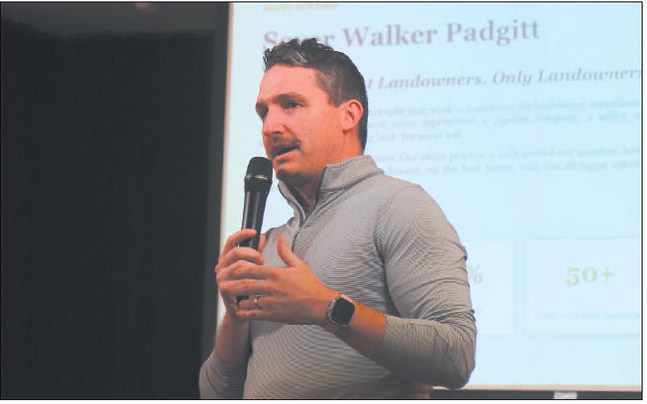
Walker continued, “Unfortunately, if you don't give them surveying access rights, they will use the court system to get an injunction to access the property. Now, if that's a fight you want to launch, by all means. I can just say that the unfortunate reality is that surveying is pretty clear as the law states. It gives them the right to do it. And you might be wondering when the fairness comes in in this process, and there's not a ton of fairness. Really, the only fairness you're going to get is just compensation. Everything else is designed to make it easier for Georgia Power and condemners to take away.” Walker emphasized to the crowd that even though Georgia Power could take the property, they were not the sole determiner of how much money landowners received for the property. “So, they have this ability, but with that power comes responsibility, and their responsibility to you is to pay you just compensation for your property. Just compensation means it isn't up to them, it isn't up to you. If it gets to a certain point, it's up to a jury of your peers. They determine what you're entitled to. And that, of course, gets all the way to the end of the process,” he told the audience. “So, you have that right, and I like to stress that because you're going to be dealing with right-of-way agents here in a bit, if you're not already. And they like to say a lot of things. A lot of them are false. One of the things they like to say is that if you go to court, you're going to get nothing, or you're going to get less, or you're going to get what we say you get. I mean, that might happen, but they don't get to determine that. The jury determines that. You have your right to the day in court.”
He told the crowd to be careful when speaking with right-of-way agents because many of these individuals were trained to use their rhetoric to convince property owners to sign easements and accept compensation offers rather than be fully transparent. Yet, according to Walker, only properties directly affected by the lines will receive compensation – if the line is not on your land and is merely adjacent to your property, you will receive no payment.
The most important things for property owners to do is to be sure to be smart when accepting compensation offers and to negotiate an excellent property easement. “Easements are forever – money is not,” Walker remarked. “Easements are conveyances, land conveyances that convey the right to do something on your property to a specific entity or person. So unlike deeding your property, if you sold your house to somebody, the simple title, you convey the deed, you give it to somebody else, [then] they own the property. [With an] Easement, you're deeding the right to do something on a certain area of your property to an entity, in this case Georgia Power and the right to build a transmission line. The problem is, what we run into, is that what is often presented to landowners in this easement document, and what is verbally told to landowners about this easement document, is not always reflected by the easement document itself. As a matter of fact, most of them are very poorly written, and they're broad in Georgia Power's favor.”
He recounted the story of a client who signed an easement believing that it was only for a power line, only to find out it also gave the power company the option of renting the space to other internet and phone service providers to run cables. “Why would they tell you? You signed the document that said they can do whatever they want, they can do whatever they want,” Walker said. “Easement language is incredibly important. How broad is the easement? What rights are you giving to them? What rights are you relinquishing on your property?”
He continued, as he gave the citizens advice on negotiating compensation with Georgia Power, as he urged them not to take the first offer the power company gave, to avoid asking for specific amounts of compensation before doing their research to ensure the property was not worth more, and to know they did not have to hire an eminent domain surveyor throughout the process.
“It's important that you get a good price per acre. You're entitled to crop damages, timber damages. You're entitled to ground restoration damages. You can get paid for these ahead of time or after the fact. This is restoring the ground. It's important that you at least get paid for that because they don't – unless – if it's not an easement, they don't do a great job of keeping the property restored unless they have to. So, it's good to both have language that requires them to do that and get you paid for any potential issues that you might face, especially getting it paid up front because going after these guys after it's already in, unless you're suing them, good luck getting their attention,” Walker told the audience.
He answered several questions from the audience and shared his contact information if the group continued to need guidance.
Individuals are still discovering whether or not their property is included in the new powerline construction. If your property is involved in the construction and you wish to learn more about your options, call or text Sara Brown at (912) 293-2225.