

Georgia Power Eminent Domain
mrandolphadvance@gmail.com
A group of citizens gathered at the First Baptist Church in Lyons on Tuesday, May 5, to get guidance from an Eminent Domain Attorney on how to handle an emerging situation caused by the construction of a new highvoltage power line.
In recent weeks, residents on the eastern side of Toombs County received notification that Georgia Power was intending to gain access to the citizens’ land through eminent domain law to construct a high-voltage power transmission line, which will run from Plant Hatch through Toombs, Emanuel, and Jefferson Counties to the Wadley substation. The proj-
continued from page
ect stretches between 45 and 65 miles, and uses extremely high voltage lines, sending around 500 kV of power through these lines.
The group of citizens, led by Sara Brown and Melinda Morris, previously met to try to piece together the exact path of the line, as though many landowners have been contacted by Georgia Power, they have not received a complete map of the project. They met again on Tuesday, May 5, to hear from an expert in eminent domain law to gain guidance on how to handle the situation.
Eminent Domain Attorney Jordan Walker – from the Sever, Walker, and Padgett firm – spoke at the meeting, as he explained he had become an expert in the subject. Walker has practiced law for 15 years and has only represented landowners in eminent domain cases. He is licensed to practice in Georgia, Illinois, Indiana, Texas, and Missouri, and has a home office near Alpharetta, Georgia. He has done numerous cases dealing with pipeline and power line work.
“We’ve accrued quite a bit of knowledge and experience about how these projects work and how these companies operate,” he began.
Walker said that though he has represented landowners in cases regarding power lines, these larger, higher voltage lines have only recently become more common, as they are necessary to power data centers. “The reason they're being built is to meet the demands that are being created by data centers, which, of course, is driven by AI. So it isn't a coincidence that with a heavy investment in AI and that type of infrastructure comes the need to transmit energy to these locations, these substations, to meet this capacity,” he explained.
He continued, “I don't want to get it twisted. These transmission lines are not being built, in my view, to help out the general populace so much as they are being built to satisfy large companies investing in AI. Unfortunately, that commentary doesn't do a lot. It isn't factored into the law. The fact that ultimately the purpose of these lines is maybe not necessarily as commonly enjoyed as they may present it as, that is not an argument against them. It is merely an unfortunate reality that we find ourselves in with these lines being built.”
Walker defined eminent domain, as he explained that though the concept is the seizure of private land for public use and the proposed project does not seem to serve most of the public, this argument will not stand in court. “The law gives a lot of deference to companies like Georgia Power, like Georgia Transmission. These utility companies, semi-private companies, have this ability to condemn that is delegated to them through statute under Georgia law. So, because they have this power, this ability, you saying no to them from now to eternity may not necessarily accomplish what you want because they have the ability, inherently, to take you to court, to sue you, to file a lawsuit against you to get your land for the purposes of the project. That's called eminent domain,” he clarified.
Walker also stressed that he understood the citizens’ concerns, as the power lines that are slated to be built were larger than normal transmission lines, and normally were found in non-residential, open areas.
He overviewed what these landowners can expect throughout the process, as he stated there were three stages of the negotiations: surveying, offering, and only if there is no deal, condemnation. Walker believes that currently, the project remains in the surveying phase of the project.
“I believe that there's surveying going on, maybe some soil boarding, surveyors coming out, talking to landowners, wanting to check out the property to do their surveying for the line. That is the beginning of the process as we see it. Surveying is the first kind of on-the-ground visualization you'll see of them there, putting something on your property or doing something on your property,” he explained. “Once
13A continued from page
the surveyors come out, it isn't a done deal by any means, but you're inching towards land acquisition, and after land acquisition comes construction. So if you have a surveyor out, or if they haven't been out yet, I assume they'll be out eventually, one thing I want to touch on now because I'm sure it's something you guys are curious about. Do they have the right to survey your property even though you don't give it to them? And the answer is they do.”
Walker continued, “Unfortunately, if you don't give them surveying access rights, they will use the court system to get an injunction to access the property. Now, if that's a fight you want to launch, by all means. I can just say that the unfortunate reality is that surveying is pretty clear as the law states. It gives them the right to do it. And you might be wondering when the fairness comes in in this process, and there's not a ton of fairness. Really, the only fairness you're going to get is just compensation. Everything else is designed to make it easier for Georgia Power and condemners to take away.” Walker emphasized to the crowd that even though Georgia Power could take the property, they were not the sole determiner of how much money landowners received for the property. “So, they have this ability, but with that power comes responsibility, and their responsibility to you is to pay you just compensation for your property. Just compensation means it isn't up to them, it isn't up to you. If it gets to a certain point, it's up to a jury of your peers. They determine what you're entitled to. And that, of course, gets all the way to the end of the process,” he told the audience. “So, you have that right, and I like to stress that because you're going to be dealing with right-of-way agents here in a bit, if you're not already. And they like to say a lot of things. A lot of them are false. One of the things they like to say is that if you go to court, you're going to get nothing, or you're going to get less, or you're going to get what we say you get. I mean, that might happen, but they don't get to determine that. The jury determines that. You have your right to the day in court.”
He told the crowd to be careful when speaking with right-of-way agents because many of these individuals were trained to use their rhetoric to convince property owners to sign easements and accept compensation offers rather than be fully transparent. Yet, according to Walker, only properties directly affected by the lines will receive compensation – if the line is not on your land and is merely adjacent to your property, you will receive no payment.
The most important things for property owners to do is to be sure to be smart when accepting compensation offers and to negotiate an excellent property easement. “Easements are forever – money is not,” Walker remarked. “Easements are conveyances, land conveyances that convey the right to do something on your property to a specific entity or person. So unlike deeding your property, if you sold your house to somebody, the simple title, you convey the deed, you give it to somebody else, [then] they own the property. [With an] Easement, you're deeding the right to do something on a certain area of your property to an entity, in this case Georgia Power and the right to build a transmission line. The problem is, what we run into, is that what is often presented to landowners in this easement document, and what is verbally told to landowners about this easement document, is not always reflected by the easement document itself. As a matter of fact, most of them are very poorly written, and they're broad in Georgia Power's favor.”
He recounted the story of a client who signed an easement believing that it was only for a power line, only to find out it also gave the power company the option of renting the space to other internet and phone service providers to run cables. “Why would they tell you? You signed the document that said they can do whatever they want, they can do whatever they want,” Walker said. “Easement language is incredibly important. How broad is the easement? What rights are you giving to them? What rights are you relinquishing on your property?”
He continued, as he gave the citizens advice on negotiating compensation with Georgia Power, as he urged them not to take the first offer the power company gave, to avoid asking for specific amounts of compensation before doing their research to ensure the property was not worth more, and to know they did not have to hire an eminent domain surveyor throughout the process.
“It's important that you get a good price per acre. You're entitled to crop damages, timber damages. You're entitled to ground restoration damages. You can get paid for these ahead of time or after the fact. This is restoring the ground. It's important that you at least get paid for that because they don't – unless – if it's not an easement, they don't do a great job of keeping the property restored unless they have to. So, it's good to both have language that requires them to do that and get you paid for any potential issues that you might face, especially getting it paid up front because going after these guys after it's already in, unless you're suing them, good luck getting their attention,” Walker told the audience.
He answered several questions from the audience and shared his contact information if the group continued to need guidance.
Individuals are still discovering whether or not their property is included in the new powerline construction. If your property is involved in the construction and you wish to learn more about your options, call or text Sara Brown at (912) 293-2225.

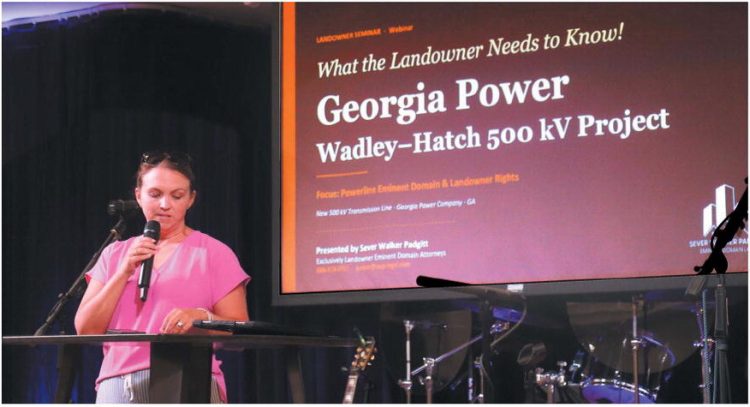
CONCERNED CITIZENS – Several Toombs County citizens have been meeting to discuss the construction of a highvoltage power line, which will run through many people’s properties.Photo by Makaylee Randolph

EMINENT DOMAIN EXPERT – Eminent Domain Attorney Jordan Walker spoke to Toombs County citizens about how to handle negotiating compensation and easements with Georgia Power during a meeting on Tuesday, May 5.Photo by Makaylee Randolph