


Calhoun Gives Last College Update
mrandolphadvance@gmail.com
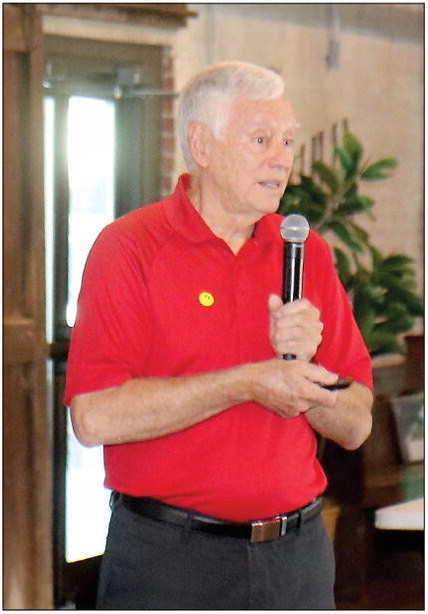
During the Vidalia Kiwanis Club meeting on Tuesday, June 23, Southeastern Technical College (STC) President Larry Calhoun gave his last update on the College before his retirement.
Calhoun officially retired from leading the College on Tuesday, June 30, after having served as the institution’s president for 8 years. In preparation for his retirement, he spoke to the Vidalia Kiwanis Club for one final time as the College’s president, as he wanted to update the Club on the work that the College was doing in the community.
He began by explaining that the College’s mission focused on three things: technical education, adult education, and economic development, as he stated that most people only think about the technical education side, without realizing the College’s work in adult education and economic development.
Calhoun emphasized that adult education is a growing focus of the college, as around 7,000-8,000 Georgians obtained their General Education Degree (GED) last year throughout the Technical College System of Georgia. “That’s good news that we did that many, but the bad news is we had another 35,000 kids drop out of high school. So, we’re not gaining on that project,” Calhoun remarked. “When I first came on board [with the Technical College System of Georgia] 28 years ago, we had one way that you could do GED. Now, we have about five different ways that you can get an actual high school diploma. There is no reason that any person – young or old – should not have their high school equivalency [degree] now.”
When discussing economic development, he told the Kiwanis Club that those courses are not worth college credit, but help to keep businesses and organizations thriving through opportunities, such as CPR-training, driver’s education classes, and more. STC’s economic development education is focused in the College’s location on 100-A Brinson Road in Vidalia, rather than on the main campus.
Calhoun shared that the College is one of 22 technical colleges within the state, and is founded upon four core values: integrity, respect, quality, and teamwork. The College is available to a service delivery area population of 116,000, and served over 500,000 students last year.
One of the newer services that the College has developed is the Quick Start and employment services, which come through a partnership with the Georgia Department of Labor. “Quick Start is an agency that helps new businesses come into Georgia, and they're one of the main reasons that Georgia has continued to be the top state to do business for the last 12 or so years, according to a site selection magazine,” he said.
He informed the audience that the popularity of technical education was continuing to grow, as the Technical College System of Georgia had over 40,000 students graduate with degrees, diplomas, and/or certificates last year.
Calhoun shared several statistics comparing the Technical College System (TCSG) of Georgia and STC: Retention Rate: TCSG – 66.8%; STC – 73.1% Graduation Rate: TCSG – 77.8%; STC – 84.0% In-Field Job Place ment Rate: TCSG – 92.6%; STC – 89.2% Total Job Placement Rate: TCSG – 99.7%; STC – 98.9% According to Calhoun, last year, a total of 2,627 students were enrolled – of these, 1,198 students were enrolled in dual enrollment courses during high school, and 766 students graduated.
He provided the audience with the College’s 2025 Pass Rates, as the Dental Hygiene, Associates of Science in Nursing, Radiologic Technology and Mammography, Paramedic, Medical Lab Technology, Medical Assisting, Phlebotomy, Commercial Truck Driving, and Cosmetology programs have a 100% pass rate. The Practical Nursing Program follows closely behind with a 96% pass rate, followed by Nurse Aide – 89%, EMT – 88%, and Advanced EMT – 67%.
He spoke of the challenges that the College faces, as he stated that the institution’s service area covers 3,000 square miles, but has a low population density of around 40 people per square mile. This issue affects the College’s ability to offer programs in both the Vidalia and Swainsboro campuses because of small class sizes.
Calhoun explained that in addition to the two campuses, Southeastern Early College and Career Academy (SECCA) in Vidalia, and Educating, Developing, and Growing Emanuel (EDGE) College and Career Academy in Swainsboro, the College is also providing classes for prison inmates and partnering with over 10 schools.
He spoke about the enrollment demographic, saying, “Most of our students either work full-time and come to school parttime or they work parttime and come to school full-time. Most of them are part-time. 66% of our students are female, and 34% are male. About 40% of our programs are health or healthcare, and females tend to gravitate to that, which is a good thing. We do try to encourage some “non-traditional [study]”, where you have a male in the nursing program or you have a female drive a truck. They do really well, but there's not much interest in that yet.”
Calhoun said that 70% of the students took classes online, but would come to the campus and do handson work or labs, and that 45% of the student demographic were first generation students or employed while working in their field of study. A total of 38% of the College’s students are economically disadvantaged.
He told the audience that one of the fastest growing student populations was the Hispanic students, and that the College has structured its programs to allow students to gain multiple certificates during their studies; that way they may be employed more quickly. “They can get a job if life happens, which it does with a lot of our students. But at the end, the longer they stay with us, the more employable they are,” he remarked.
Calhoun recalled a conversation he had with a Georgia Southern University professor, during which the professor explained that for every manufacturing engineer hired at companies, around 20-25 technical school graduates were needed to work with them, as he emphasized the importance of technical education.
Overall, Calhoun clarified that STC has a $65.9 million impact on the area and state’s economy.
He stated that 361 students had received financial assistance and scholarships in 2025, as the STC Foundation had raised over $600,000 through contributions and grants to improve the College and help students. Of this funding, $38,580 came from STC employee contributions, and over $67,000 was awarded to students for scholarships.
He also informed the audience about the College’s upcoming initiatives, which are to increase efforts to grow apprenticeships, to advocate for funding for welding lab renovation, to increase funding for the STC Foundation, and to increase enrollment with inmates within the Department of Corrections.
Calhoun ended the address by sharing his hopefulness that the College will continue to thrive, as he explained that he was grateful for the opportunity to have led the institution for several years.