

continued from page liament was ….
continued from page
liament was taxing men who had no voice in Parliament, in direct violation of the most fundamental right of an Englishman. “No taxation without representation” became a rallying cry.
In New York, delegates from nine colonies gathered for the Stamp Act Congress and sent a unified petition to the King voicing their opposition. Parliament repealed the Stamp Act the following year. Then, almost immediately, they passed something equally as infuriating.
The Townshend Acts of 1767 imposed duties on glass, paint, lead, paper and tea—goods the colonies could only purchase from Britain. The colonists responded by boycotting those items. Merchants signed non-importation agreements. Drinking imported tea became an act of submission, and more than a few drawing rooms switched to coffee.
Through all of it, Samuel Adams of Boston was pulling strings. Brilliant and restless, Adams was the revolution’s great organizer—a man who understood that outrage called for a well-thought-out plan. He helped found the Sons of Liberty, a network of resistance cells that stretched from Massachusetts to South Carolina, and established the Boston Committee of Correspondence to keep colonial agitators connected and coordinated. Paul Revere, a silversmith with a talent for both fine engraving and fast horses, served as one of Adams’ couriers. (By the way, the British regarded Sam Adams as one of the most influential, dangerous men in the colonies, and they were right.)
The Tea Act of 1773 may have been the oddest provocation of all. Parliament actually lowered the price of tea—granting the nearly bankrupt East India Company a monopoly that undercut colonial merchants—while keeping a small symbolic tax in place. Colonists could now buy cheaper tea, but they defiantly refused.
The colonies were no longer willing to negotiate, and furious, magnificently stubborn Boston was about to show the world what true resistance looked like. A City That Refused to Back Down
Some cities complained, but Boston did more than complain.
By the late 1760s, the British Army had stationed 2,000 soldiers there, and the tension between the redcoats and the colonists had become a daily occurrence. The escalation finally broke on the evening of March 5, 1770, when a crowd of dockworkers and laborers began taunting a small British guard post on King Street with snowballs, small objects, and perhaps some profanity. The soldiers reacted by firing shots. When the smoke cleared, five colonists lay dead, dying or bloody on the cobblestones.
One of them was Crispus Attucks—a tall, mixed-race dockworker, part African and part Wampanoag, who had lived for years as a free laborer on the Boston waterfront. He became an instant martyr. The Sons of Liberty gave all five men a public funeral that brought ten thousand people to the streets of Boston. Samuel Adams called the incident “a massacre,” a term that spread like wildfire.
Within weeks, silversmith Paul Revere had produced an exaggerated engraving of the scene that would circulate throughout the colonies. It depicted British soldiers firing into a peaceful crowd—the officer with a sneer and the sky thick with smoke. Almost nothing about the engraving was accurate, but it would become one of the most effective pieces of political art ever made in America.
The legal aftermath produced one of the revolution’s great paradoxes. John Adams—cousin of Samuel and future president—defended the British soldiers in court. He believed that every man deserved a fair trial. Arguing that the crowd had provoked the confrontation, six soldiers were acquitted, but two were convicted of manslaughter, had their thumbs branded as punishment and were released. Rather than ruining his reputation by defending the British soldiers, Adams’ approval ratings somehow grew stronger. Go figure!
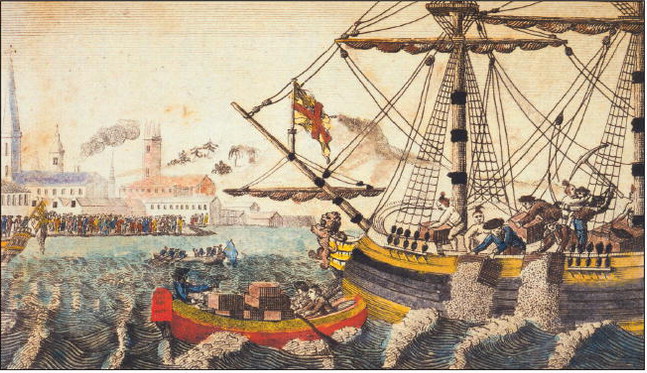
Three years later, Boston delivered its most audacious act. On the night of December 16, 1773, somewhere between 116 and 130 men—many poorly disguised as Mohawk warriors—boarded three ships at Griffin’s Wharf and spent three hours dumping 342 chests of East India Company tea into the harbor. The cargo was worth roughly 10,000 pounds sterling—the equivalent of nearly $2 million dollars today. Not a single ship was damaged. The destruction was a powerful protest statement.
Parliament’s response was swift and furious. The Coercive Acts of 1774—what the colonists immediately dubbed as the “Intolerable Acts”—closed Boston Harbor entirely, replaced the Massachusetts assembly and gave the royal governor sweeping new powers. Governor Thomas Hutchinson, who had spent years trying to have Samuel Adams tried for treason, only to find that no Boston jury would touch the case, was replaced by a military man, General Thomas Gage. London was determined to make Boston an example to the rest of the colonies.
The other 12 colonies, rather than distancing themselves from Massachusetts’ radicalism, rallied to it. In September 1774, delegates from every colony but Georgia gathered in Philadelphia for the First Continental Congress—the closest thing to a unified American government the continent had ever seen. They agreed to a sweeping boycott of British goods and to meet again if things did not improve.
Shots Fired
It was a secret plan. On the night of April 18, 1775, 700 British Regulars slipped quietly out of Boston and marched to Lexington to arrest Samuel Adams and John Hancock. They also intended to press on to Concord to seize the colonial arsenal stockpiled there. If successful, by morning, the rebellion’s leadership would be in captivity, and its weapons would be confiscated by the British. It was to be a clean, quick, undercover operation.
But Boston found out that trouble was brewing, and they, too, had a plan.
Paul Revere had built one of the most effective intelligence networks in the colonies. That night, Sexton Robert Newman climbed the steeple of the Old North Church and hung two lanterns in the window—a prearranged signal meaning the Regulars were crossing the Charles River by boat rather than marching out by land. Indeed, in school, we all learned of Paul Revere’s instructions: “One if by land, two if by sea.” And so Revere was already crossing the river, slipping past the HMS Somerset in the darkness. On the far bank, a horse waited for him.
You may remember the Longfellow poem lines that say, “Listen, my children, and you shall hear, about the midnight ride of Paul Revere.” But did you know that Revere was not the only messenger on horseback that night? William Dawes rode out by a different route, carrying the same warning. Later, a third rider— a young Concord doctor named Samuel Prescott—joined them on the road. It is Prescott’s name that deserves far more recognition than history has given to him, because he is the only one who completed the ride. Revere didn’t make it! He was stopped by a British patrol outside Lexington, held at gunpoint, and released without his horse to walk back to town. Dawes was thrown from his horse and never remounted. Prescott alone leapt a stone wall, cut through the fields and reached Concord before dawn with the important message. Legend often attributes the shout, “The British are coming,” to the midnight riders, but historical accounts suggest Prescott and his companions likely used the phrase, “The Regulars are out.”
By the time the British arrived at Lexington Green, the town was awake and waiting for them. Seventy-seven militiamen had assembled on the common in the gray pre-dawn light, facing 700 professional soldiers in perfect formation. The colonists’ militiamen’s captain, John Parker, was 45 years old and dying of tuberculosis. He had fought in the French and Indian War, knew what disciplined British infantry could do, but he showed up anyway. History says his orders to his men were for them to stand their ground and not fire unless fired upon, adding, “But if they mean to have a war, let it begin here.”
To this day, no one knows who fired the first shot. Eight colonists died on that green, one Redcoat was wounded, and the British marched on toward Concord, where, at the North Bridge, the militia was no longer retreating. They held formation, they aimed, and they fired back. Deliberately. Together. Strong. Unbelievably courageous.
Today, it is known as “the shot heard round the world”—a term used by Ralph Waldo Emerson in his 1837 “Concord Hymn.”
And so the British began their march homeward to Boston. For 16 miles, colonial farmers, cobblers, shopkeepers, tavern workers—harassed the British along what is now called Battle Road, firing from behind stone walls and tree lines. By the time the British staggered back into Boston, 73 Redcoats were dead, and 174 men were wounded. The most powerful army on earth had been bloodied by men with little or no munitions experience—men who had been working fields just the week before.
Still, no one was ready to call it a revolution— not yet. But the line had been crossed that morning.
From Lexington to Independence
Within a few weeks, thousands of colonial militia members and volunteers had surrounded the city of Boston. Meanwhile, leaders from the colonies met in Philadelphia at the Second Continental Congress to figure out what to do about the growing war. In June 1775, they picked George Washington to lead the new American army, called the Continental Army— smart move!
That same month, the two sides fought the Battle of Bunker Hill, which was actually fought mostly on nearby Breed’s Hill in Massachusetts. The British technically won the battle, but it cost them many soldiers, so both sides realized this fight wouldn’t be easy or quick. Washington’s troops later fortified Dorchester Heights with cannons overlooking Boston Harbor, forcing the British out of the city in March 1776.
Around this time, more and more colonists began to get used to the radical idea of breaking away from Britain completely. A writer named Thomas Paine published a pamphlet titled “Common Sense” that convinced many people that independence was the right choice. Then, on July 4, 1776, Congress officially adopted the Declaration of Independence, declaring that the colonies were now their own country—free from British rule.
Thomas Jefferson wrote most of it, with this noteworthy line: “We hold these truths to be self-evident, that all men are created equal, that they are endowed by their Creator with certain unalienable Rights, that among these are Life, Liberty and the pursuit of Happiness.”
That’s our beginning right there in black and white, and here we are 250 years later—a free nation of opportunity.
But the Revolutionary War didn’t end with the Declaration of Independence. The months and years after the signing were rough for revolutionary Americans. The British captured New York City in September of 1776 and almost wiped out Washington’s army. But Washington pulled off a surprise attack, crossing the Delaware River on Christmas night through dangerous winter conditions and winning battles at Trenton and Princeton. These wins gave everyone hope again.
In 1777, the Americans won a huge victory at Saratoga, forcing an entire British army to surrender. This win was a big deal because it convinced France to officially help the Americans, sending ships, money, and soldiers. Spain and the Dutch Republic eventually fought the British, too.
That winter, Washington’s army camped at Valley Forge in eastern Pennsylvania, and it was nothing short of brutal. Soldiers struggled with freezing cold and didn’t have enough food or supplies. An officer named Baron von Steuben took Washington’s tired, hungry group of soldiers and turned them into a real, organized army. Serving as the Inspector General, he taught the troops how to march and fight in proper formations, made sure the camp stayed clean to cut down on illnesses, and even wrote the army’s first training manual. Thanks to his work, the Americans were finally ready to go toe-totoe with the British.
A lot of the fighting moved south, to places like the Carolinas and Georgia. These battles got messy, with regular fighting mixed with smaller ambush-style attacks. American wins at King’s Mountain and Cowpens in South Carolina weakened the British in the South. General Nathanael Greene also wore down the British army little by little, even when he didn’t win outright.
Yorktown (in Virginia) effectively ended major military operations in North America in October 1781. American and French forces teamed up, and the French navy blocked the British from escaping by sea. British General Cornwallis was forced to surrender.
After that, the British were more willing to talk, and in September 1783, they signed the Treaty of Paris. Britain officially recognized the independence of the United States and gave up land stretching all the way to the Mississippi River. The treaty also settled other issues, like fishing rights and what would happen to people who’d stayed loyal to Britain during the war.
Even after winning the war, America still had problems to solve. The system they’d been using to run the country (the Articles of Confederation) just wasn’t enough. This eventually led to a big meeting (Constitutional Convention) in 1787 where they wrote the Constitution, the document that still guides us today.
Final Words
Since the signing of the Treaty of Paris in 1783, the United States has grown from a brand-new experimental country into one of the most powerful nations in history. The leaders who wrote the Constitution in 1787 built a structure strong enough to survive a civil war, hard economic times, and world wars, while still evolving over the years through changes that ended slavery, gave women the right to vote, and expanded freedom to more and more people.
American innovators went on to light up cities, harness the power of the atom, and even land people on the moon, while hardworking Americans built one of the strongest economies the world has ever seen. Through it all, the same revolutionary spirit has helped the country push through its toughest moments. Americans have shown again and again that working together can overcome even the biggest challenges. The soldiers and leaders who fought for independence could never have imagined the country their sacrifices would create, but here it is: not perfect, still working on itself, but free, strong, and full of hope.
Our country can feel terribly divided sometimes. We argue, we struggle, and we disagree something fierce. But underneath all of that, we all love this nation.
Almost all of us are deeply grateful and proud to be American citizens; grateful for the freedoms we sometimes take for granted; and grateful for the people throughout history who paid an awful price so we can live the lives we live. That gratitude doesn’t cancel out the hard stuff—it just gives us a reason to never give up on our country or our people.
So don’t let this milestone birthday slip by like just another summer. Crack open a history book. Read the Declaration of Independence and think about the words. Fly your American flag high. Talk to your kids about America’s roots. Wear red, white and blue. Hug some veterans. Buy a cup of coffee for active service members. Plan a road trip to Boston or Philadelphia and walk the same cobblestones our founders walked. Watch the fireworks this July with tears in your eyes. Sing patriotic songs: America, America, God shed His grace on thee!
Two hundred and fifty years is something to celebrate, so happy birthday, America. We love you, and we have faith in you. We’ve still got work to do, but what a ride it’s been—one glorious 250-year ride!
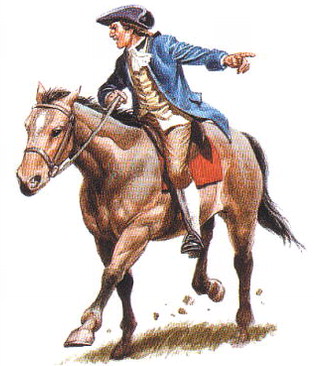
Paul Revere