
continued from page eastern side ….
continued from page
eastern side of Toombs County received notification that Georgia Power was intending to gain access to the citizens’ land through eminent domain law to construct a highvoltage power transmission line, which will run from Plant Hatch through Toombs, Emanuel, and Jefferson Counties to the Wadley substation. The project stretches 75 miles, and uses extremely high voltage lines, sending around 500 kV of power through these lines.
“We are very, very early on in the process,” Georgia Power Representative Joshua Peacock remarked. “They’re still doing surveying. So, we have not even approached or completely finalized the line yet.”
He explained that currently, the company is working to engage with parcel owners that they know will be impacted by the line. “We want to have them come out, speak with our professionals and experts, and ask their questions. Hopefully, we can provide a lot more information so that they’re clear on what the project is, why it’s important, and what the impact might be on their particular land or their community. So, that’s the purpose of these meetings,” Peacock said.
He continued, “I think it's important to note, too, that as a regulated utility, we have community meetings that are legally required when we do construction projects. That is not what we're doing here. This is us volunteering to come to these communities tonight and talk to these folks early in the process and get their questions answered. Down the road, once we get to that stage, we're going to have more public meetings, and those will be part of our legal obligation when it comes to constructing these lines. So really, tonight is about just trying to engage with those potential impacted parcel owners and answer their questions. We want them to come out.”
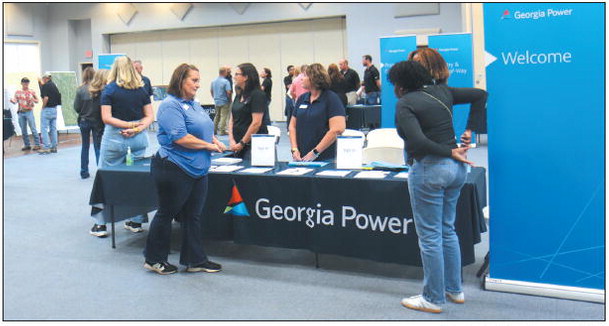
Representatives from several departments within the Georgia Power company – Land, Environment, Customer Assistance, Line Construction, etc. – were set up in stations to allow attendees to address experts on various topics.
“This line is really part of our statewide effort to make a more reliable grid to meet the demand of a growing state and a lot going on. So we call it the Hatch- Wadley Line – that means it's going to be a transmission line, which is a high-voltage line. That does not go into anybody's house. They go from generation to a substation or substation to substation. Then, the substation takes smaller voltage distribution lines to people's houses,” Peacock clarified.
Peacock said that the goal of these line constructions are to make a more reliable and resilient grid to meet the growing demand and help avoid widespread power outages. “There’s some redundancy built into our system. Also, across the state, we've got a lot of aging infrastructure. So we're trying to upgrade that and make it endure worse storms, more reliable for our folks, more redundant so we can keep the power,” he explained.
When asked why the line was selected to originate from Plant Hatch when geographically, Plant Vogtle was closer, Peacock replied, “Hatch has been our workhorse for a long time. It's been in [production] for a long time. It just got recertified for another 20 years. So, this was a really important piece of our infrastructure. When we look at these things from an engineering perspective, there's a very holistic look at how to move the power through the state. That’s really what transmission systems do – think of them like the interstate system. It's a fast-moving, high-powered line. So, we identified a need to run more power out of Hatch and into these areas – that’s why this line was designed.”
He continued, “So Vogel, obviously, too, is a huge asset for our state – good on nuclear power. It's clean energy – big, beautiful, clean energy. So, I'm very proud that Hatch is going to have definitely another couple decades of service, and it's going to be able to have us continue to power the state.”
“So it just really is like a full engineering game that they have to look at when they're examining this,” he added. “They’re juggling a lot of factors. It’s complicated. It’s a lot of math.”
When asked if data centers were the underlying cause in the creation of this new line, Peacock said, “We have not been shy about the fact that data centers are coming to Georgia. These are what we call large load customers. It's really important to note that these are our customers – they're coming to us. We have an obligation to power, and we're doing what we can to meet that demand. But unlike other places and other states, we are leveraging that growth to ensure that we keep, number one, rates low for our residential and small business customers, but also improve the infrastructure around it. So, this line is not being built to serve one single customer or one single facility. It is being used to power all of these communities. And I think that's really important.”
He added, “Across the state, it's just going to make the grid more reliable for this area and be able to keep flowing energy in. And as things grow and it makes sense for that community, we're going to be able to be there to provide the power for that community. You know, that growth in our state has been good. That growth has helped us a lot. I live down in Savannah. We've seen that growth bring jobs, bring economic success, create more opportunities in our community. So we support that growth. And understanding, too, and balancing out the needs of our communities that are impacted.”
Peacock explained that around 403 parcels will be affected by the line construction, as he said that the location of the line was determined by looking an the community and environmental impact of the construction, as this impact would have taken twice as much land had the company merely used the existing right of way.
“We understand that property ownership is very personal. We’re empathetic to that. We totally get it. There are employees [of Georgia Power] on this line that are impacted. So, that’s why we’re here without any obligation to be here to answer folks’ questions,” he remarked.
Peacock said that the company chose to do a more individual approach to asking questions to provide a personalized experience for parcel owners without having to fight for space or volume in a larger town hall meeting style. “The hope here is, again, that we can engage with everyone who's impacted. They can come out, they can ask their questions in each individual area, and hopefully get some good answers when they leave,” he shared.
The timeline of the construction of the new Hatch-Wadley Line is: Quarter 2 of 2026: Survey Notification to Landowners Quarter 3 of 2026: Community Meetings Quarter 4 of 2026: Easement Acquisition Begins Quarter 1 of 2027: Line Clearing and Grading Begins Quarter 4 of 2027: Line Construction Begins Quarter 1 of 2031: Project Completion. More information on the line is available online at the Georgia Power website. A local group of landowners are currently meeting on several occasions to discuss their options for their affected parcels. For more information on these meetings, call or text Sara Brown at (912) 293-2225.