continued from page organization sought ….
continued from page
organization sought to provide necessary health supplies and support to rural communities through the One Health approach.
“The One Health approach just basically is kind of the idea that human, animal, plant, environmental health is all connected. The machine right now may not have that much of a direct connection to that, but everything we do tries to come back to that. The second part of One Health is just interdisciplinary collaborations. It means people with different backgrounds working together to solve problems, and that's a big focus for us. That's something we think about in all the projects,” remarked Project Lead Jennifer Drey.
Drey explained that she first interacted with Toombs County during the Community Health Resource Project, which worked to highlight and map health assets in the community to determine its strengths. “One of our goals was to find ways to strengthen health, and this project is part of that,” she added. “During our previous work with Toombs County, we identified a need for additional health resources and found strong support from local stakeholders— particularly the library. Vidalia is representative of the communities where we hope to expand this program.”
She explained that after conducting the Community Health Resource Project, the IHLA selected the Dr. Mark and Tonya Spivey Public Library as the location for the “care station” because of its importance within the community. “You know, the library is a community asset. The people who create the library are community assets. And we thought one of the strengths of health might be to add an access point for health supplies and things in the library, which are an existing strength. So, that's where we are,” Drey emphasized.
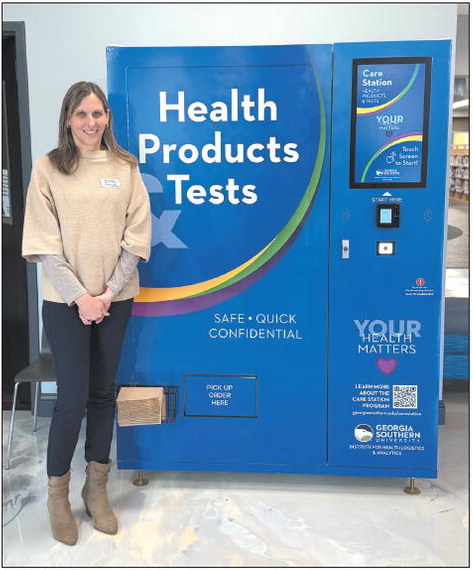
The “care station” – which aims to improve community health by increasing access to over-the-counter health products and at-home diagnostic tests — is a large health vending machine located in the lobby of the library. Within this “care station,” individuals may confidentially purchase ibuprofen, urinary pain relief tablets, baby wipes, hand sanitizer, first aid kits, bandages, children’s Tylenol, diapers, menstrual products, glucose tablets, Wavesense presto test strips, and at-home HIV and syphilis tests.
“Users tap the touchscreen and scroll through the available products,” explained IHLA Business and Financial Coordinator Kathryn Stewart. “If a user sees something they want to purchase, they may use a credit card to pay for items directly at the machine. For safety and security reasons, the Care Station does not accept cash payments.”
Project Manager Jill Johns added, “These machines are easy to use, safe and completely private. Whether someone is purchasing pain relievers or STI tests, no one else will know. That confidentiality helps remove stigma, which is often a major barrier to accessing health products.”
The IHLA will celebrate the opening of the new “care station” during an official ribbon cutting ceremony at 1 p.m. on Wednesday, March 4, in the lobby of the Dr. Tonya and Mark Spivey Public Library, located at 610 Jackson Street.
The care station is available for use during the library’s regular hours. IHLA is asking that customers share their feedback on the station’s product offerings and the experience through an anonymous online form, which can be found at bit.ly/CareStation_ Vidalia.
“By understanding the unique needs of the community, we can offer customized health products and tests in easily accessible locations. We can change what’s offered as we know more about what is needed in the area,” Drey emphasized. “These first two IHLA-sponsored Care Stations serve as a proofof- concept. Rural communities often face greater challenges than metropolitan areas in terms of accessing essential health supplies and testing. We hope this pilot demonstrates a scalable model that can be expanded to other rural communities across Georgia.”