

Public Outcry Heard:
mrandolphadvance@gmail.com
The City of Vidalia has listened to the concerns of numerous citizens who voiced their opinions at the recent public forum, spoke with their city councilman, or submitted their input on the new neighborhood overlay ordinance to City Manager Josh Beck, as a new neighborhood overlay ordinance draft was recently released by the City.
The Neighborhood Overlay Ordinance was first proposed during the July 13 meeting of the Vidalia City Council, when the Council completed the first reading of the ordinance draft that would add a new section to the City’s current zoning ordinance, allowing neighborhood residents to petition to continued from page
become a neighborhood overlay district to preserve their distinctive patterns of development, lot arrangement, walkability, building scale, civic or cultural character, historic or architectural features, and/or other characteristics through additional guidelines and rules. These neighborhood overlay districts may be used to encourage compatible development, redevelopment, reinvestment, and more of the neighborhood.
The original ordinance draft stated that these districts could dictate several standards, such as building placement, fences, accessory structures, features visible from a public street, and more. According to the original proposed legislation, neighborhood overlay districts would be created through the approval of petitions, which must be signed by property owners owning at least 10% of the parcels within the district. These petitions must include the name of the neighborhood overlay district; a description or map of the district’s proposed boundaries; a general statement explaining the reasons or justification for the district; the names, addresses, and signatures of petitioning property owners; and any other information that may be requested by the City’s Building Department, Planning and Zoning Committee, Mayor, or City Council.
All residents in the original proposed neighborhood overlay districts do not have to approve the petition for it to be submitted. The Planning and Zoning Committee, Mayor, and/or City Council may consider, revise, expand, narrow, or modify the proposed overlay district’s boundaries, standards, procedures, exemptions, and effective date without the approval of the petitions, new petition, or additional signatures as long as the City administration follows all legal requirements of notices and hearings, as the neighborhood overlay district would be dictated and voted on as an ordinance.
According to City Manager Josh Beck, this ordinance was first drafted as an attempt to address public concerns about cleaning up their neighborhoods. Beck said that he has attended public hearings and meetings in Ward 3 for around a year, during which the citizens shared that they wanted a way to get rid of blight and unkempt property to restore the neighborhood.
continued from page
He also said that citizens who lived near Julie Drive and the Jackson Heights neighborhoods had spoken out about wishing that they had a way to protect the character and quality of their neighborhoods.
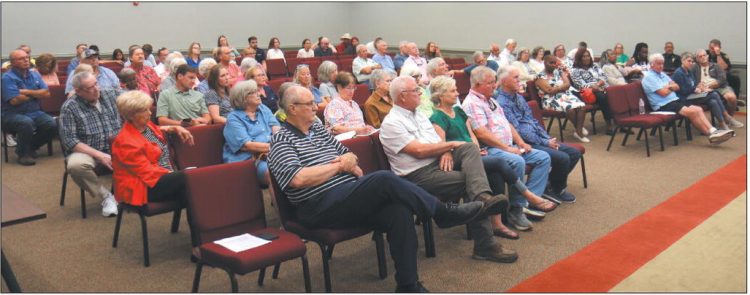
Beck stated that the City had been looking into their options such as creating a new zoning designation, but had found that neighborhood overlays were the most flexible option. The City enlisted City Attorney Daniel O’Connor to draft the proposed ordinance. O’Connor is contracted to the City and paid by the hour for such work. The City planned a forum to hear from citizens before sending the potential legislation to the Planning and Zoning Commission for discussion and a vote. On Tuesday, July 28, the Vidalia City Council Chambers were filled, as citizens crowded in to share their concerns about the legislation.
Ricky Mitchell expressed to the Council that only requiring 10% of the property owners to sign a petition for an overlay district took away at least one property owner’s rights. “We currently have good working zoning ordinance throughout our city. It is my opinion that if this ordinance is passed, its effects will be like that of a homeowner’s association,” Mitchell remarked.
“I’ve been involved in homeowner’s associations for over 30 years. In fact, I started one. I am part of these associations by choice. If this ordinance passes, 90% of the property owners in a neighborhood overlay district will not have a choice. They will have to abide by the new overlay standards as outlined in section 08, standards authorized, and you all can read what those setbacks and so on are. Planning and Zoning [Committee] has not voted on this, and I adamantly oppose this ordinance,” he added.
Former City Manager Bill Torrance also told the Council of his concerns. “For years, we have had a couple of homeowners associations. I’m in one, and it’s a loose homeowners association. It was just gathered together to get information together and meet together, but I’ve seen over the years, the efforts of some to override what our zoning ordinance is currently like and to dictate what happens in those associations.” He began. “That concerns me because I know from my own experience that it’s very difficult to enforce the zoning ordinances as they exist right now. You have the ability to change the ordinances as they exist right now, and I think, through the Department of Community Affairs, there is a land-use plan procedure that you can follow that would give you opportunities to adjust things. I kind of like being able to look at a small area.”
He continued, “One of the things Josh mentioned was that if there’s multifamily dwelling not allowed, but in a small area next to downtown, you saw a need for what this would allow for that. That makes sense to me. But the enforcement is a concern, and also with the homeowners association reference, we’ve always had a position that the city does not enforce the covenants of the homeowners association.”
“I would be very cautious that that’s exactly where you’re headed because if an overlay is proposed by the 10% [of property owners], which I think is a small number too, if you’re going to have a large percentage of the people all want to change that area if it comes to the council. But once it comes through the council and then those new ordinances or new covenants are in place, then it’s up to the city to enforce those covenants, it seems to me. So, I’d be very careful about that because there are some special interests. Historical preservation may be one of them, and that’s not a knock on anything. I have seen where historical preservation has gone so far that when a tornado came through and knocked the house down part of it, to go through the regulations that had been imposed, the people decided to tear the house down rather than repair it. It can be a double-edged sword…Proceed with caution, and get as much input as you can,” he concluded.
Bernie Nelson addressed the Council and stated that he was unaware of the potential ordinance until it was being discussed in the community, which disappointed him. He stated that he had lived in Georgia for several years and continued to live in the community because he loves it here. “I love this city – it’s not Los Angeles, California; it’s not New York. We need to think about that – this is a step in the direction of a whole bunch of restrictions, and it’s a Homeowners Association on steroids,” he said.
continued from page
Harry Moses spoke in favor of the ordinance, as he remarked, “I was around when this effort started over a year ago. It didn’t start in our neighborhood association. It started right down here at City Hall in a discussion of how our in-town neighborhood could be of a better benefit to the downtown. The city has spent a lot of time, a lot of money, a lot of effort in improving downtown, and anything that could be done with the residential, adjacent residential areas seemed to be a good idea.”
Moses added, “We toyed with some ideas, but the overlay idea, which has been used in other communities, was the smoothest it could be, and it still appears to be, the smoothest and the most effective way to get some small changes made that would help. We’re not changed by any of this. Any promulgation of regulations, procedures, that we go through now, by any zoning council, does not create a historic district. We have a historic district ordinance on the books, I believe, but no district has been created, but that is not suitable or appropriate for one of the ideas was that this would be unfair or uneven, but it’s just like the process we have now, and I don’t think people consider that unfair or uneven. It’s the same thing that you have to go through now.”
He concluded by emphasizing that many of the negative comments he heard about the ordinance – such as it creating a Homeowners Association or causing commercial property to be sold as residential property – were false according to the proposed ordinance.
Sharon Dodds questioned the Council if the creation of this ordinance would be a conflict of interest because of the City Council having the ultimate authority to approve or deny overlay districts, rather than the citizens or neighborhood residents, as she emphasized that she felt that the lack of ability to appeal these decisions to a separate board felt unfair.
Dan Brown echoed Torrance’s statements and urged the Council to “proceed with caution” as he felt that the proposal was “an unnecessary extra layer of regulation.”
Realtor Pat Hadden warned the Council that if this ordinance passed, it would not attract people to move to the City, but deter them. “Now, I’m for us continuing to advance because we’re a great town. But you have to remember; we’re a small town. When people come in here, they love Vidalia. And the reason they love Vidalia is we have good schools, we’ve have great recreation departments, we’ve got a good downtown, but what you’re fixing to do is you’re fixing to stop that. If I were a person that were coming into Vidalia, I wouldn’t come in the city limits. I would move out here in the county somewhere and honestly, probably in Montgomery County,” she emphasized.
Connie Williams told the Council that she did not know the ordinance existed or was being considered until she read about it
Photo by Makaylee Randolph
in a previous edition of The Advance. She shared that she was concerned that this new legislation would give her neighbors the power to control her home – and specifically, her pink door – if they had a disagreement with her.
Numerous other individuals – including Sam Page, Jack Todd, Peggy Roundtree, Carl Delebar, Johann Reichster, Joe Warden, Julie Morgan, Mike Holland, Jason Horton, and Mac Jordan – spoke of their disapproval of the ordinance, citing that they did not want the City or their neighbors to be able to control the color of their homes or other outward appearance issues, or for their property to be controlled by 10% of their neighbors.
On Thursday, July 30, the City released a new draft of the Neighborhood Overlay District, which took out many of the controversial aspects that were shared by the public.
The new ordinance, which is much more concise than the originally proposed legislation, clarifies that an overlay district may be established to apply additional zoning standards to a small defined area while leaving the underlying zoning district in place. These new zoning standards are in accompaniment of the zoning standards already in place and do not replace the current zoning, but merely add to it within the district.
The new document does not feature the detailed list of possible standards that can be enforced through the Neighborhood Overlay District, and the legislation states that only the types of zoning standards authorized by the City’s Zoning Ordinance could be enforced. This means regulating the color that someone may paint their property and other smaller details is not possible.
The new document also omits the special petition process, which required signatures from owners of at least 10% of the parcels within a proposed overlay area before an overlay district could be formally considered. Instead, these overlay districts may only be considered through the City’s existing zoning amendment process, through which individuals may ask the Planning and Zoning Committee to review an area for zoning, the City may review an area for zoning, or Planning and Zoning Committee may review an area’s zoning. Once this request is made, both the Planning and Zoning Committee and the City will hold hearings to gain public input on the change before voting on the request.
According to the new ordinance draft, no separate overlay permit is created, and the ordinance does not require a new permit or approval for work that does not otherwise require one under the City’s Code of Ordinances or Zoning Ordinance. These overlay districts are directly under the control of the Planning and Zoning Committee and the City Council.
The revised draft confirms that any future overlay district must be proposed, reviewed, adopted, amended, or repealed in the same manner as other zoning ordinance amendments.
The new draft also clarifies that no separate review board, commission, private association, private covenant, or private enforcement authority is created or authorized by the ordinance – no Homeowners Association or other private organization can be established from this, no one is required to join a Homeowners Association, and no private organization has authority over anyone else’s property.
The ordinance’s most recent draft also features a nonconforming use clause, otherwise known as “grandfathering,” meaning established properties that do not abide by any future neighborhood overlay district rules are not required to change to conform to that rule.
The City will hear the public’s concerns with this new draft of the ordinance at 5:30 p.m. on Tuesday, August 18, in the City Council Chambers. The Planning and Zoning Committee’s meeting and public hearing, originally scheduled for Tuesday, August 4, was postponed until Tuesday, September 1, to allow the public time to review the new copy of the ordinance before discussing the potential legislation.
Comments, concerns, or questions about the ordinance may be submitted to City Manager Josh Beck by emailing jbeck@vidalia. gov or by calling (912) 537-8718. Copies of the ordinance may be found online at www.vidalia.gov, or by calling the Vidalia City Hall.
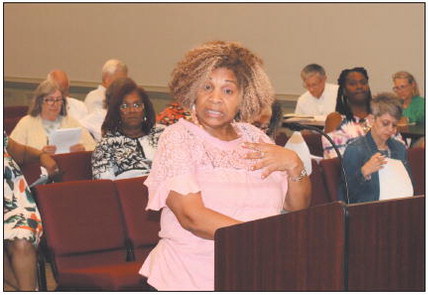
CONFLICT OF INTEREST – Sharon Dodds tells the City Council that she feels it is a conflict of interest for there not to be a separate body to review appeals of neighborhoodoverlay districts.Photo by Makaylee Randolph
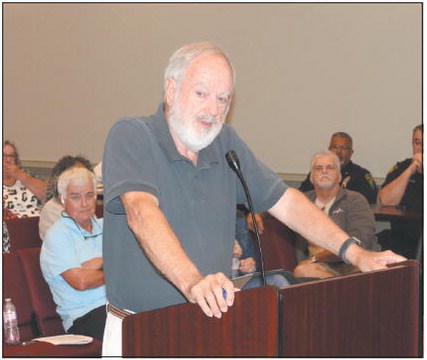
NEGATIVES NOT IN DOCUMENT – Harry Moses stated that many of the negatives that citizens shared about the ordinance were not in the original document.