

State of Rural Development
mrandolphadvance@gmail.com
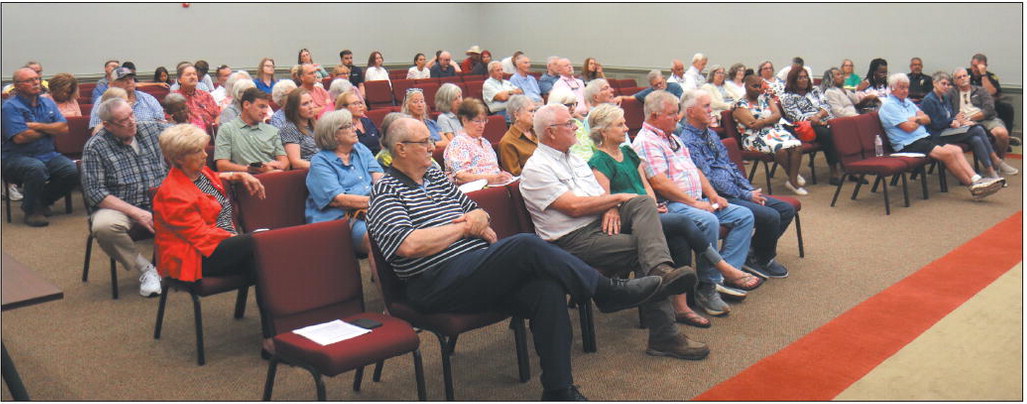
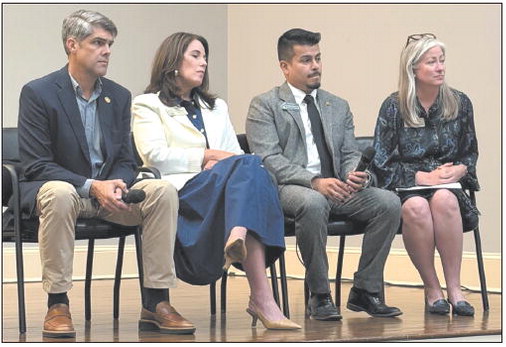
Local community members were able to learn more about what is currently occurring in rural development and what will come, as State Representative Leesa Hagan and several others shared information about their work with the House Rural Development Committee.
The Committee became an official permanent committee last year, with Toombs County Resident and State Representative Hagan chairing the 15-member group, many of whom attended the event.
“We are one of the smaller committees in the House out of our around 42 standing committees we have, but I like it that way because every one of our members is highly qualified,” Hagan emphasized. “They are absolutely distinguished. This committee cannot be stacked with better legislators from around the state.” She continued, “I want you to understand that this is a committee that has some very important legislators on it, and also legislators who are experienced in their different fields in a very diverse way. We bring that to the table here when we’re talking continued from page
about rural issues.” Hagan explained that the Committee’s job is to review potential legislation that is assigned to them by the House to determine its affect on rural development. “Rural development has been and still is a priority of mine as a legislator, and it is the priority of these legislators and of this committee because of where we live,” she remarked.
She and several members of the committee spoke to the audience about taxes, healthcare, agriculture, forestry, education, entrepreneurship, and workforce development issues, as they shared information about legislation that will come up in upcoming sessions and new initiatives that will impact rural Georgia – which, by the legislature’s definition, is any county that has under 50,000 people. According to Hagan, that means 120 of Georgia’s 159 counties are rural by this definition, but the inhabitants of those counties only make up 20% of the state’s population.
TaxesR epresentative Shaw Blackmon led the discussion on taxes, as he overviewed the House’s battle to provide homeowners with property tax relief. He explained that the Senate Bill 33 had found a way to provide some property tax relief through the implementation of a sales tax, either through the Floating Local Option Sales Tax (FLOST) – which disperses relief for all types of property through the same methods as Local Option Sales Tax (LOST) – or the Local Homestead Option Sales Tax (LHOST) – which provides tax relief primarily for homesteads before providing any other type of property with relief.
He continued, stating that study committees had been formed to focus on local government taxation, funding, and budgeting so that officials can travel the state, talk to elected officials, and see what the best practices are.
“This year, hopefully, you filed your homestead exemption. This is a roughly $500 reduction or credit towards your property tax for all homeowners across the state. So, that was an $880 million investment on the budgetary side that the House put in and made it through the process,” Blackmon remarked.
Healthcare
Representative Leo Chancey spoke on healthcare, as he explained that the State made extensive investments in healthcare during the last session.
“As some of you already know, we have a proficient shortage in the state of Georgia. Rural health is definitely difficult to sustain, but there's also other medical experts and professionals that we need more of in our state,” he explained. “To address this future healthcare workforce need, the governor was able to direct $2.1 million for 105 residency slots. This is the graduate medical education that produces physicians in the state of Georgia. Originally, we passed $2.8 million with the House and Senate, but $750,000 was disregarded. So, we had 123 reduced down to 105. However, in the amended budget, we did put $72.8 million for new residency slots in South Georgia. We have a total of 103 that will be coming in this final quarter here this year.”
Chancey continued, as he shared that the amended budget also delegated $100,000 to expand the Medical College of Georgia’s partnership with Clark Atlanta University for prostate cancer research, and provided $250,000 for screenings. In addition to this, the institutions will work with the Department of Public Health to develop a strategy to build awareness and prevention for prostate cancer.
An additional $3.7 million of the budget was earmarked to expand maternal home visiting programs to provide additional coverage to 33 counties, increasing maternal medication in attempt to combat maternal mortality. The budget also included $3.2 million to establish new grant programs to support rural medical and dental clinics.
The state legislature is also working to invest in mental health access for schools in rural Georgia, as they delegated $1.3 million for K-12 grants to increase social workers in underserved districts, and an additional $1.6 million for additional social workers in all areas. “That's a total of $4 million being invested for mental health access in those schools,” Chancey emphasized.
He said that the legislature is in the works to address shortages of optometrists, providing additional funding for medical education and student loan forgiveness.
A bill is also being discussed that will make the definition of rural hospital organizations to include rural freestanding emergency departments, forcing it to be licensed to provide maternal and newborn services or have at least 5% of its annual net revenue categorized as indigent care, charity care, or bad debts.
State legislators have also created a bill that establishes a grant program to acquire and install active generators in certain rural hospitals that already do not have this equipment. “The Department of Community Health will work with GEMA, the Georgia Emergency Management and Homeland Security Agency, to set the criteria for these grants. Then, this funding will, again, go through the Georgia General Assembly on a case-bycase basis. So this means that nonprofit, not-for-profit acute care hospitals, typically fewer than 100 beds, will have access to these active generators if they're located in a region of the state that the governor has declared a state of emergency,” Chancey explained.
The final bills which he discussed created a limited professional license to allow internationally trained physicians to practice in a rural county and eventually, receive a full license after four years, and to increase access of rural counties to contraceptives.
Agriculture and Forestry
Representative Jaclyn Ford began her address by emphasizing the importance of agriculture, as she stated, “Agriculture is one of Georgia's top economic drivers, and its success is critical to our state's future. I think we can all agree with that.”
She continued, as he explained that the state had spent two years investing over $1 billion to provide direct relief to Georgia’s farmers, timber growers, and rural communities, plus additional surplus for emergency management, farm loans, and more.
In addition to this, $200 million of forestry tax credits have been offered by the state’s treasury as revenue credits to cover timber, reforestation, and other expenses. Millions of dollars of local revenue reimbursements have also been added to the state ledger to directly compensate rural county government for local timber harvest tax exemptions mandated by the TREES Act.
Ford shared that 5,874 people had applied for the Department of Agriculture Block Grants, and officials were going through the applications carefully as they prepared to disperse the $531 million. “They're having to go through the applications very carefully. A lot of times they're having to call back people and get more documentation, supportive documentation, so that they can get that done. They're thinking it'll probably be the fall before that money actually goes out. They do not want to do it in rounds like they've done in the past where they've done it in rounds. It only stays in Georgia. So, that's why it's taking a little bit,” she clarified.
She explained that the widespread destruction from the wildfires in Brantley County caused a lot of concern for the future of rural Georgia, as he explained the County has many displaced residents and not enough rental housing. “We're not sure what the lingering effect would be for those communities where people lost their homes. Are they going to come back? Are they not going to come back? That's definitely an issue that we're concerned about for rural Georgia,” she remarked.
Ford also shared that HB1085 was passed to protect the future of Georgia Forestry, as it strengthens income tax credits for forestry manufacturers. “The Forestry Association was really excited about that because we've lost several [forestry industry businesses], we've had all these mill closures for forestry and so this is something that really encourages development and new jobs,” she told the audience. “What this means is Georgia already had two major business tax credits – a jobs tax credit and an investment tax credit – that certain manufacturers could earn. The problem for many forestry manufacturers is they didn't have enough tax liability to actually use those credits. So, this bill makes those credits transferable for qualifying manufacturers. Many of the companies can sell those tax credits.”
Another agriculture change being discussed is the Cougar Bill, which double the maximum acreage allowed under the Conservation Use Evaluation Assessment from 2,000 to 4,000 acres; this change will be on the ballot as a referendum question in November.
Ford said that other legislative measures were in place to increase the Farmland Conservation Fund, allow hunters to decrease the wild hog population, expand access to veterinary medicine, and designate cotton as the state’s official fabric. She also explained that the Water Management Plan from 2008 which streamlines the way the water districts are aligned had been amended by the Georgia Association of Conservation Districts.
Education
State Representative Hagan shared many changes that had occurred in education, such as banning students from having cell phones while at school and the ability for school boards to create safety instruction classes through a partnership with the Georgia Department of Natural Resources.
She also spoke about is House Bill 1193, the Georgia Early Literacy Act, which establishes grants to local public schools that have K-3.
“So, if they have K-3 students it enables them to receive funding for a school-based literacy coach. It does a lot more than just that but that's what I really want to talk about right now is the importance of getting these literacy coaches in our schools,” Hagan told the audience. “For a very long time, including when I was getting my education degree, teachers are taught to instruct in a certain way and the data is showing that that doesn't work. So, these coaches are going to be in these schools to help our teachers begin teaching according to the science of reading because that is where the data shows our kids are going to learn to read again.”
She continued, as she explained that a lot of students’ future success was built on the foundation of reading on grade level in third grade – thus, the legislature is prioritizing early literacy reform and improvement.
Hagan spoke about a bill that will potentially provide needed childcare for working parents during afterschool hours, and new provisions to give high school students the chance to learn more about the workforce and entrepreneurship.
Question and Answer Session At the end of the discussion, the representatives fielded questions from the audience, as they shared more on each topic.
The State of Rural Development is just one of the Greater Vidalia Chamber’s many “State of” events – for more information on these events, visit the Chamber’s website or call (912) 5374466.