

Citizens Speak Out Against Potential Subdivision
mrandolphadvance@gmail.com
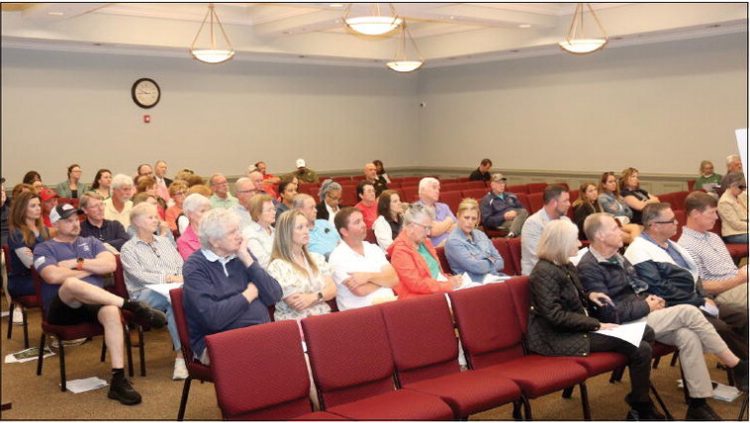
The Vidalia City Council Chamber was filled with concerned citizens on Monday, April 6, as the Council hosted a public hearing regarding the rezoning of over 50 acres of agricultural land into a planned unit development (PUD) site for the construction of 50 starter homes.
On March 25, the Vidalia Planning and Zoning Board met to decide whether to recommend the zoning change of 51.23 acres on Larry Drive from A-1 (agricultural) to PUD (Planned Unit Development) to allow the owner – Ricky Mitchell – to build a residential subdivision to address a workforce housing shortage. Each home is slated to be between 1,200 and 1,400 square feet, with the target prize range being between $220,000 and $292,000.
Citizens addressed the Board with their concerns regarding the development, but the Board still agreed to recommend the change on a 4-1-1 vote, with Board Member Brian McDaniel objecting to the recommendation and Board Member Russ Bell abstaining from voting. The final decision now lies in the hands of the Vidalia City Council, which will vote on the zoning change at the Coun- continued from page
cil’s monthly meeting at 6 p.m. on Monday, April 13. In preparation for this vote, the Council hosted a public hearing on Monday, April 6, to hear from the developer and the public on their perspectives of the proposal.
“We had two options, and a lot of councils would have chosen to do this differently than what we have chosen to do tonight. The majority of the time this public hearing [for a zoning change] is incorporated into the regular meeting – meaning, we would hear from the public and we would take the vote that same night. We felt like this issue needed its own night designated for this topic and this topic only. There'll be no vote tonight. Tonight is about hearing from both parties, both sides, and then the vote will be taking place a week from tonight at our regular meeting,” Mayor Doug Roper told the attendees.
City Manager Josh Beck began the hearing, recounting the process which Mitchell had taken to get the zoning change and clarified information regarding the Rural Workforce Housing Grant that Mitchell had informed the Council that he intended to seek.
He explained that Mitchell was seeking to designate the land as a PUD because of the zoning’s flexibility with setbacks and changes regarding the planned development, and that he had issued a formal notice to the City that he planned to apply for the grant.
This grant issued by the state was created in response to a statewide housing study, which found that rural Georgia was in critical need of workforce housing.
“This $2.5 million grant is for infrastructure for the homes – it is not for the construction of the homes,” Beck clarified. “The City of Vidalia will be a pass-through for this money. We will not receive this money and hold it in any interest-bearing account. We will simply try to file for reimbursement. So, as the project pursues and advances, the City of Vidalia will issue paperwork asking for this reimbursement to take place, and the reimbursement is strictly for infrastructure – roads, water, and sewer improvements. It is not for any down payment assistance for anyone trying to buy the homes themselves.”
Beck also told the attendees that though the construction of rental properties was eligible for the grant, the homes were not intended to be rental homes. “We have been approached by other developers in the City of Vidalia to pursue rental development projects using this grant. We have declined the partners of other developers because of the need of homeownership and the trend of homeownership and where we currently sit. We want to reverse that trend. So, this grant application, if zoning were to pass and if it were to be awarded, would be for a homeownership development, not a rental development,” he explained.
He stated that provisions, such as this one, would be assured through a contract with the developer that is submitted to the state. Based upon this contract, Mitchell would be held responsible if he did not follow the agreed plan to help protect the City’s interest.
“There will also be a local match and this local match varies. What I mean is the City of Vidalia will be required to participate out of our own funds in this project. That rate ranges from 15% down to 5% and it's based on the population of the city and if things have happened in the project – for example, if proper zoning has been processed through this grant application. We will get certain bonus points for that, and it will decrease the local match rate, which will only fund infrastructure for the project,” Beck said.
He informed the attendees that previously, a two-year term had been given to developers to complete the project, but after realizing that this time limit was extremely difficult for rural areas, extensions have now become available.
Beck assured attendees that the City was concerned about potentially “flooding the [housing] markets” without following through with the development. He summarized this effort, remarking, “We're not just going to simply push out a 70-home development, flood a market, and then that 70-home development is not actually happening. We need a good relationship with the State of Georgia and we need to make sure that the projects we pursue are paying and that we can reach our goals. Again, I want to emphasize this is a State of Georgia grant that they awarded. It's a communitybased grant and the City of Vidalia will be a passthrough agency for this grant. We are not going to give out $2.5 million, and the grant will be for infrastructure. It will not be for home construction, down payment assistance, or for construction of homes.”
Comments From the Developer Developer Ingrid Dykes – who told the audience that she was one of the developers overseeing the project alongside her father Ricky Mitchell, stepmother Nissa Mitchell, and brother Joey Mitchell – addressed the Council and the public on behalf of the developers.
She told the attendees that her family had considered the idea for several months after learning about the grant opportunity form city officials, and ultimately chose to move forward with the project because they believed it would benefit Vidalia.
Dykes continued, “Right now, our housing market is unbalanced. Rental prices are high and starter homes are scarce. Just this week in the paper, there are two rentals listed. One is a three-bedroom, two-bath for $1,750 a month and one is a threebedroom, two-and-a-half bath for $2,100 a month. I personally know many people that are paying $1,200 to $2,000 a month in rent without building any equity. At the same time, a 2024 housing report shows that over 6,900 people commute into Toombs County every day for work, many of whom would consider relocating here if housing were available. 87% of homes in Toombs County were built before 2010. That tells us two things very clearly. We are not building enough housing and we are missing an opportunity to grow our workforce and our community. The reality is there are people who already work here, want to live here, and can afford to live here. They just don't currently have the right housing options. This project will help address that.”
She said that the homes that are planned to be built on the property will be smaller and more attainable for homebuyers, as the houses are built with quality exterior construction of hardy plank and brick with attached garages. She assured the lots would abide by the R-1 requirement of being at least 20,000 square feet, and that the lots on Chesley and Julie Drives would be larger than 20,000 square feet to be comparable to those neighborhoods. She stated that the developers have planned to have a 25foot natural buffer from the adjoining property lines, and that around 5.8 acres of space had been set aside to give to the City.
“We've made several changes based on community feedback. For example, we have reduced the overall size of the development from 69 to 50 homes. We've listened and we've adjusted this plan to be more compatible with the surrounding community,” Dykes emphasized.
She explained that these homes would not be built all at once, but rather in phases, as the first phase would construct 20 to 25 new houses in the projected subdivision, and that future phases could be delayed if the initial houses did not sell. “This development is not meant to compete with existing homes. It's meant to fill a gap. Right now, we have larger homes but very few options for first-time homebuyers, single people, smaller families, and those looking to downsize,” Dykes told the audience.
She added, “I want to be very clear about two important points. First, this community is designed for home ownership. Through reported deed restrictions, each lot will be permanently limited to a single-family detached home. No duplexes, no apartments, no subdivision into multiple units, and no short-term or long-term rentals. We intend to deed restrict to the fullest extent of the law. Secondly, the DCA grant is strictly for infrastructure, roads, water, sewer, and site development. Regardless of hearsay, it does not go to individual buyers.”
Dykes told the audience that anyone purchasing a home will still need to qualify for a traditional mortgage. Any down payment assistance would come from separate existing programs not tied to this development.
She also stressed that this is not a “high-density development, but an effort to provide homes for individuals looking for something bigger than an apartment but not a large, custom home.
“I understand there are concerns, especially about traffic and property values, and those are valid concerns. This project will not happen overnight. Infrastructure alone can take up to two years. That gives us time to work with the City to evaluate traffic patterns and make improvements where needed, particularly on Larry Drive. Also, we do support exploring additional access points to help even out traffic. Regarding property values, this is not a rental-heavy or low-quality development. It is designed for homeownership and long-term investment. What protects property values is quality, planning, and strong home ownership, and this is exactly what we intend to create. Finally, this project brings a $2.5 million state investment into Vidalia, supporting infrastructure and growth without placing that burden solely on current taxpayers,” Dykes summarized.
She concluded her address by emphasizing that her family was not trying to bring any harm to the City but rather improve it. “We are not asking to take away something from Vidalia. Vidalia is our home, and we are willing as local developers to invest in its future. Again, please note that this was not an idea that we as local developers came up with, but rather something that the City officials approached us about,” she remarked. “If we want our children to come back after college, if we want to attract industry, and if we want Vidalia to continue to grow and remain competitive within the state of Georgia, we have to provide housing options for people. So, the question becomes, do we as a City want to grow responsibly or stand still and let the opportunity pass us by? I believe that we all want a strong, thriving Vidalia.”
Fred Godbee then spoke in support of this development, as he said it was imperative for the continued growth and success of Vidalia. “I don't want Vidalia to become Wheeler County, Montgomery County, or Telfair County. Two of those counties are in the top five in the nation for per capita poverty. That's not a direction we want to go. If we don't have growth, we will go there. The only way to have growth is to have viable infrastructure — housing for people who want to come and build a family here,” he told the Council.
Godbee continued, as he spoke on the importance of available housing so that the school system did not suffer. “Without a viable city school system, which requires teachers to have housing, we're done. So, I request y'all really consider that when you're going through this. I think that Ricky's family and this development will be fine. I'm not speaking per se on that. I'm speaking about development, and if we're going to continue to delay it and not do it, this city will go downhill. So that's your call.”
“I would hate to be sitting in your place, though, and voting for something knowing that, unless you have a better plan. The other thing is, if you had a fourto- two vote, a four-to-oneto- one vote out of zoning and planning, my concern is if y'all vote against them, I guess you need a new zoning and planning commission, because you're basically giving them a down vote if you vote against it,” he concluded.
Former Toombs County Development Authority Board Member Harry Moses also addressed the Council to support the development, as he stated that it satisfied a critical need that had been discovered during a local housing study conducted in the County in recent years.
“Housing stocks improvements are needed. Young professionals, young families, seniors, and others are underserved. In the comprehensive plan, the projections for future land use, which is an important guide for zoning and other infrastructure activities, all the property within the city limits between Highway 130 South and Highway 280 West is zoned for future residential. That includes the property in question. That said, what zoning conditions are appropriate?” he remarked. “The proposed is residential PUD with lot sizes that match R1, the current zoning for the contiguous neighborhoods. Why PUD, not just R-1? PUD allows the director to create higher standards than city zoning code establishes. Those conditions are protective of the development and surrounding neighborhoods. Once these conditions are reported as deed restrictions, they are permanent. They will provide property value protection.”
He went on to explain that development was needed, as the County had added over 1,100 jobs since 2010, and the population had increased, in addition to the housing study concluding that housing was desperately needed even without these differences, as he emphasized that available data justified the need.
Opposition From Neighboring Homeowners Greg Crosby – a resident of Julie Drive – began the discussion of the opposition to the subdivision development.
He began by stating that any information that he shared had been collected from city ordinances. “One of the first things it says in the ordinance is that it promotes a stable character that is in harmony with surrounding development and should maximize the use of open spaces. So, the question tonight isn't whether development should happen in general. I think we can all agree that we need development. The question is whether this particular place, this particular location, satisfies the stated purposes and uses objective criteria like compatibility, access and safety, and the amount of usability of an open space,” Crosby told the Council.
Crosby addressed the project’s density, which averages around 0.98 acres per home. “I don't really agree with what the plan could do,” he continued. “The nearby subdivisions, from Julie Drive to Mary Drive and everything in between, we're looking at .37 to .77 homes per acre density. I still maintain that it's substantial and that this development is not in harmony with the surrounding neighborhood. So we don't maintain the high availability for this plan and the layout and the transitions inadequately address what is needed to be in harmony with the neighborhood.”
He explained that he also has concerns about the increase of traffic throughout the neighborhood, as continued from page
he explained that Larry Drive only has “one way in and one way out,” making emergency access very difficult to the area. “How are we going to handle that traffic? And we look into that. Do we have a solid plan for what we're going to do around this emergency area? We're creating 50 more homes inside and down in one-way streets,” Crosby told the Council.
Crosby stated that though the houses were being built specifically with affordability concerns in mind, that the current estimated prices are not affordable for a majority of the working class within the city. “A common standard is that housing should be no more than 30% gross income. Under that benchmark, the income range we're talking about is $694 to $1,209 per month for housing costs. So, let's look at mortgages. If we take a $220,000 home and a $290,000 home, and if we had money to pay 20% down, we would have payment ranges mortgage only going from $1,171 a month to $1,544 a month – that’s before we add tax and that's before we add home loans and insurance. So that's why I'm saying the attainable benefit is not supported by this class,” he remarked.
He added, “Another thing that I want to address is attracting in county workers, people that are commuting here and do not live here. Again, I'm going to use the income thing. The materials that we've seen don't demonstrate that we're pricing it for a large share of that workforce. It just simply doesn't hit it. I'm going to quote directly from the housing study — 19% of the workforce comes from the retail trade. Their average affordable payment is $710 a month. That's not even close to what I just described to you. So, it's simply speculative to claim that this rezone is going to meaningfully convert commuters into residents.”
Crosby also debated against the belief that this development would help to increase the number of homeowners in the area, as he stated that there was no way to ensure these homes would not be purchased then rented out to other tenants.
He questioned if the City had any information or plans regarding emergency access, traffic improvements, or infrastructure costs. City Manager Beck answered these questions, as he explained that without any improvements to current infrastructure on the roads, it would be less than $1 million to install infrastructure for the housing, and that there would be an emergency access point on Julie Drive that is only accessible to first responders and public safety. He explained that a traffic study had been completed and issues reported to the Georgia Department of Transportation.
Crosby concluded by asking Council members to think about the PUD criteria and the issues that had been brought before then when voting on the incident.
Numerous citizens took to the podium to share their concerns about and opposition to the development, as each asked for the Council to either deny the zoning change or defer it until further studies could be done.
Former Toombs County Development Authority Chairman Garrett Wilcox explained that local economic development thrived on unselfishness, as the Authority was not focused on attracting new businesses, but taking care of existing businesses. He used this to emphasize the need for the City to take care of their existing citizens rather than focusing on attracting new citizens.
“We need new development as far as housing goes. I will not stand up here now like I hadn't had those conversations because I have. I just didn't feel like the feelings of the group in the room, obviously, that's here opposed, that lives in that area, got a very empathetic ear. That's my feeling. I'm not speaking for anybody else,” he remarked.
Shelly Wilson asked for the City to complete an environmental study for wildlife because she had learned that an endangered woodpecker was native to the Georgia pine trees, and could halt the project if one bird was dwelling in the area. City Manager Beck informed Wilson that to receive the grant, the City would have to complete a concise environmental study.
She also emphasized that the single Zoning board member who voted against the development was the only individual on the Board who lived in the area and would be directly impacted by it. “Now, it's very, very easy for all of us to say, yes, I vote yes to that because it's on the other side of town. It has nothing to do with me,” she commented. “I agree we need more housing, but let's think about the impact and that the one negative vote was from the president, and how easy it is to say, yes, let's do it when it's on the other side of town.”
When Financial Advisor Brad Owens spoke, he explained that he had a degree in economics and had been a financial advisor for several years, and had been consulting with his mother and brother who were experienced and successful real estate agents. “I don't think there's anybody in here, anybody, that believes that there's any way that this development is going to increase the value of the homes that we live in, the neighborhood that we live in. I would think that it's a very safe bet to say that it's going to be detrimental. I think that when you look at the economics of this, we don't live in a country where we take money from one group of people so that we can give it to somebody else. And essentially, that's what's going on here. We're sacrificing $30,000, $40,000, $50,000 a piece — which, if you add up 70 homes, is $2.5, $3.5 million — so that we can build housing — no matter how neat — housing with government money so that we can get this built and built at a cheaper price than it would be done if it were done entirely privately, hoping that we can lure people who don't live here, who don't have a lot of money, who haven't lived their life here, who haven't kept businesses here, who aren't this community, to come here. I'm opposed to that,” he said.
He told the Council that several existing residents in the neighborhood plan to put their homes for sale and move elsewhere if the development goes through, meaning that these individuals – many of which who are vital to the community’s wellbeing because of volunteer work – will leave.
“It's not fair. I don't care how you slice it. There are so many places that we can put it and bring a neighborhood up instead of down. Wouldn't that make sense? Wouldn't that make sense to increase the property value around where you're going to build it instead of decrease it? I mean, I'm not an economic genius, but that's what I do every day for a living. And I think I know a little bit about dollars and cents. And that makes sense. This don't make sense,” he told the council before asking if any of them would like to have the development by their homes.
Realtor Pat Mitchell shared his concern about the large increase of traffic that the development will bring, calling it “overwhelming.”
Another citizen questioned the legitimacy of the statistic that over 7,000 people were driving into the area to work each day, as he stated Plant Hatch as a whole employed only 1,000 people. He also told the Council that he was concerned that the new subdivision would erase the small neighborhood charm that surrounded the community, making the area lose its attractive qualities. He suggested waiting until the development is actually needed, as he was not convinced of the necessity.
Elaine Deloach stated that she had moved her family to the neighborhood several years ago in an effort to have a safe place for her children and grandchildren; yet, she emphasized that because of the increased amount of traffic, the neighborhood would no longer be a safe area for children to play. “And I will urge you to deny this and for no other reason than what you're going to do to disturb our neighborhood, for these young children and our grandchildren that we love more than we love our own lives,” she concluded.
Dustin Hall told the Council that these projected homes were not traditional starter homes based on prices, and although he understands the need for housing and believes that Mitchell would build quality homes, he disagreed that Larry Drive was the appropriate place for the subdivision. “People worked and saved for years to build a home they could retire in here. You are trying to put starter homes next to people’s last homes,” he summarized.
Terri Humphrey asked Council members to refrain from approving the development until the subdivision construction on Center Drive was completed to see if there was still a need for these residences. She also suggested polling the 7,000 individuals driving into the area for work to see if they desire to live in Vidalia rather than building homes for them without knowing if they even desire them. Edna Shirley told Council members that this new development would be in her backyard, and even with the promised natural barrier, she did not want to see construction occurring for two years. She also argued that this new subdivision would not be comparable to the current neighborhood, as she remarked, “I don't feel like this community is going to be anywhere compatible to the community that we have now. We have a great family-oriented neighborhood. We know our neighbors. We look after our neighbors. And I'm sorry — I don't want this in my backyard. I don't think there's a person on this council that would want this backed up to their house.”
The hearing concluded with no further public comments. The Vidalia City Council will meet again on Monday, April 13, at 6 p.m. in the Council Chambers at the John Raymond Turner Municipal Annex, located at 312 E. First Street, to vote on the issue. For more information, or to voice your opinion on the development, call (912) 537-7661.
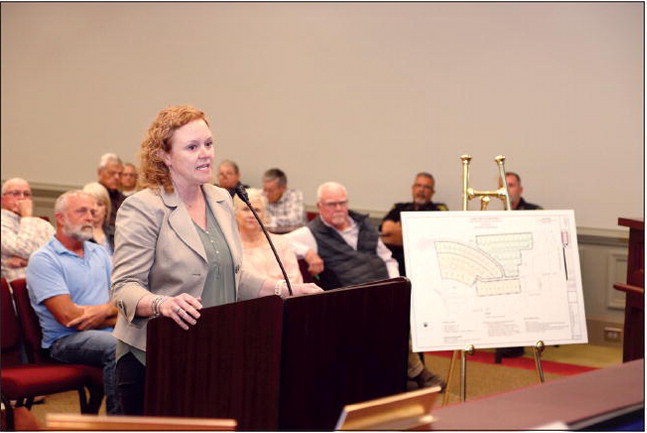
EXPLAINING THE PROJECT – Developer Ingrid Dykes spoke to the Council and the public about the potential Larry Drive Subdivision Project on behalf of her father, stepmother, and brother. (Photo by Makaylee Randolph)Photo by Makaylee Randolph