


The Big Dig

From the Porch
By Amber Nagle
If you know me, you know I’m a science girl— always have been.
Growing up in middle Georgia, my family often dug up limestone out of the backyard and found imprints of seashells and ancient plants pressed right into the rock. The idea that our corner of the world had once been covered by an ocean fascinated me.
Back in those days, I’d wander into the library or bookstore and walk out with armloads of books about dinosaurs and archaeological discoveries. In fact, there was a season in my childhood— as there is for many kids— when I wanted to become an archaeologist when I grew up. Then I realized that archaeologists tend to work in places like Egypt and Central America. I love relics and discoveries, but I love my family more. So I quietly eliminated the archaeology and paleontology career paths from my options.
The dream, though? That never really died. Even 20 years ago, when my husband Gene and I vacationed out in Utah and Colorado, we made a point of stopping at Dinosaur National Monument to watch the staff carefully uncover bones from the earth. I really loved that!
So last month, when I spotted an invitation to join an organized fossil dig in Northwest Georgia, I hit the “sign me up” button, turned to Gene, and said, “We’re going!”
This past Friday, we drove about an hour north of home to a beautiful place called Lula Lake Land Preserve. We gathered with two bona fide archaeologists and around twenty regular folks just like us. We had buckets, rock hammers, picks and chisels. We meant business.
One of the archaeologists, a fellow named Daniel, gave us a short talk explaining that despite standing at a fairly high elevation, we were on ground that had once been an ancient swamp. The mountainous land beneath our feet had risen up millions of years ago when the North American and African tectonic plates collided and assembled the supercontinent Pangea—forcing ancient seafloor rock to fold and push skyward. Rain and erosion did their work over the millennia, leaving behind layers of limestone, sandstone, and shale packed full of secrets.
Daniel added, “You’ll find mostly plant fossils. Ferns—but not ferns like we have today. Ferns that no longer exist anywhere on this earth.” He showed us examples, and my excitement quietly caught fire.
He also promised we’d each find something. And he warned us, sensibly, to keep only our best pieces. “Rocks get heavy on a mile hike out,” he said.
I looked at my husband. “I’m going to be pretty upset if I don’t find a good fossil,” I said. We hiked a mile to a creek site continued from page
lined with mounds of coal tailings left over from an old mining operation. Our technique was simple: dig out chunky rocks the size of a dinner plate that looked somewhat layered on the sides, chisel the edge, and split them open like an open-face sandwich to see what was hiding inside.
We got busy, balancing on the side of a mound. Within minutes, I looked down and spotted a perfect fern impression on a small piece of rock—just sitting there in the leaves. We didn’t even have to crack that one open. “Look!” I hollered, holding it up. Gene exhaled and whispered, “Thank God you found something.”
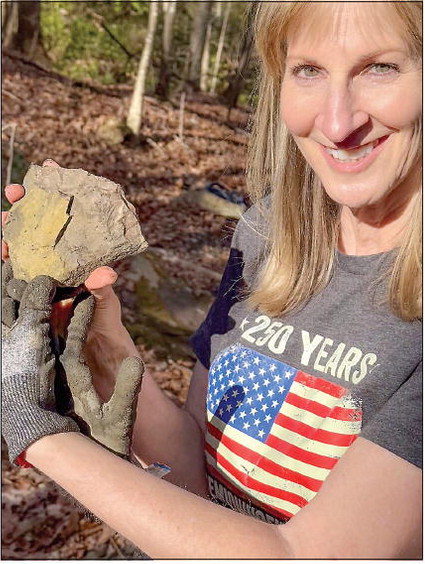
We dug for over two hours, finding a few interesting things, moving to another spot when the pickings got slim. We rested our tired arms here and there. With thirty minutes left, I uncovered a large layered rock. Gene chiseled the edge and cracked it clean open as I cradled it in my hands. Inside were perfect fern impressions. Ferns and ferns and ferns—pressed there in stone for millions of years, waiting patiently for the two of us to come along and see them and think about them. We both gasped.
“These little ferns grew here millions of years ago,” I said quietly. “And now here they are again. We know what they looked like.”
Ten-year-old me would have been absolutely beside herself. Sixty-year-old me smiled all the way home.





out of
Posted on