

Hagan Shares Priorities For Legislative Session
mrandolphadvance@gmail.com
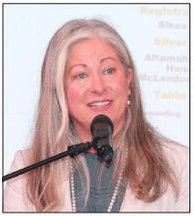
During the Greater Vidalia Chamber’s annual Legislative Luncheon on January 8, State Representative Leesa Hagan informed citizens of the House’s three priorities for the current session, as she also emphasized her focus on ensuring legislation was beneficial for rural development throughout the state.
Hagan currently chairs the Rural Devel- continued from page
opment Committee of the State House of Representatives, where she focuses on ways which the state legislature can help to facilitate growth and development in rural communities, ensuring that they continue to thrive.
“As many of you know, Speaker David Ralston had a vision to identify both the challenges and the opportunities that are specific to rural Georgia when the House Rural Development Council was formed. And I was proud to have been appointed to that council when I first began my service in Atlanta. Our mission was to use the interim period between sessions to travel the state and to learn, listen, and then make recommendations to the legislature on issues that are specific to communities like this one,” she explained. “Last January, Speaker John Burns saw fit to create the Rural Development Committee as a standing committee of the House of Representatives. And this was important because it signaled that parts of the state outside of metro Atlanta were valued and would receive the attention that they deserve. And I'm grateful that he appointed me to be the first chairman of that standing committee.”
She continued, “My top priority for the past four years has been rural development, and it is why I ran originally, Rural Development. And why? Because I want our children and our grandchildren to have the option of living a good life in the community where they grew up. So I look forward to focusing on that in the future and during this session.”
Hagan shared that the Greater Vidalia Chamber would be hosting a State of Rural Development event this year as a part of the annual “State of” series. She explained that she will be holding a committee meeting subsequent to the State of Rural Development Luncheon, which will allow members to become familiar with the community and all that it has to offer.
“I look forward to having the opportunity to introduce you to many of those committee members and have you hear about what's going on in their rural communities around the state so that you can be confident that this community, this district is at the forefront in the conversation whenever rural issues are discussed,” she added.
Hagan stated that before every committee meeting begins, she asks herself and members of the committee, ‘How can we improve lives and opportunities for Georgians who live in rural communities?” She emphasized that when making decisions, she also reminds her fellow state representatives that “what is good for Atlanta is not always good for rural Georgia, but if it’s good for rural Georgia, it is good for everybody.”
She shared several of the priorities of the State House of Representatives, which centered on literacy, healthcare access, and property tax reform.
Literacy
Hagan shared that literacy has been a focus of the state legislature for several years, and is a cause very close to her own heart. “As a former teacher, I understand the power of literacy. The ability to read is the foundation for lifelong success, and a literate public is good for every one of us,” she emphasized.
“Our state has been in a literacy crisis for many years. And I'm going to make a comment that might be controversial to some of you –but apparently, our current state superintendent stated at a very recent meeting in West Georgia that we don't actually have a literacy problem in this state, and that the general assembly is overstepping and getting involved in an area where we should not. But I think every one of us realizes, whether it's anecdotally, that we do have a literacy problem in this state. I'm going to be very clear right now that I don't think any member of the general assembly could place that at the feet of our educators,” Hagan explained. “We're not here to complain, we're all here to support them, because they work very hard, and they do a very good job every day with students that are assigned to them.”
She informed the crowd that according to current data, around one in three students in Georgia have the ability to read proficiently by the end of third grade. “The word proficiently is important because many people can read the words on a page, but that's not necessarily proficient. They might be able to read the words and then comprehend that so that they can use it successfully — that's what we're talking about when we speak of proficiency,” Hagan said.
She emphasized the importance of the state improving literacy for multiple reasons, as she explained there is a direct correlation between the number of individuals incarcerated and third grade reading levels. “ So that's why it's so important to us, and I hope you too, to continue to do the work to make sure that we're giving our teachers, our educators, every tool that we have at our disposal to help them teach our students to read,” she commented.
Hagan shared that the Georgia Council of Literacy’s studies were showing that the provisions to improve literacy in recent years was raising these literacy proficiency rates. “To oversee what we're doing, the General Assembly has changed a number of literacy-focused measures in the past few years, like strengthening curriculum, increasing accessibility to dyslexia screening, and expanding resources for our teachers. And we have funded literacy coaches in every RESA already,” she explained.
She went on to explain the value of RESA (Regional Education Service Agency) districts, as she stated that they’re a valuable source of resources for teachers. Currently, according to Hagan, the RESA districts are helping to accomplish the legislature’s goal of creating a program that places a literacy coach in every elementary school.
Hagan recounted a recent visit that she took to a pre-k classroom, where she asked the teacher to identify the biggest challenge she faced, “She said, ‘They show up and they don't even know how to hold a book.’ That’s what we’re fighting,” she remarked.
Hagan addressed her excitement to address vision and hearing impacts on childhood learning, as she felt this was another key to improving literacy proficiency throughout the state. “We know that vision and hearing problems early in a child's life greatly impact their ability to learn to read. However, when identified early, accommodations can be made to help that child succeed. I've learned a lot about the impact of early vision screening from the Lyons Lions Club,” she continued. As a member of the Lyons Lions Club, Hagan has attended the Clubsponsored vision screenings at local elementary schools, and has witnessed the potential impacts of identifying sight issues at a young age. “A lot of blindness in adults and serious vision problems in adults could have been prevented if it was identified when they were in elementary school. And accommodations have been made – so, this isn't just an issue for children. It's an impact that can affect the whole community. I look forward to working with the House on that priority,” she told the audience.
Healthcare
Hagan emphasized that access to quality healthcare is crucial in rural development, as she shared her gratitude to the Memorial Health Meadows Hospital for the work it does within the community.
“For the last several years, we've been focused on increasing access to quality care for Georgians. We've been investing in medical schools and expanding them. We’ve been working to strengthen our health care workforce and also increasing access to telehealth,” Hagan said. “That's very important for rural parts of the state. Where specialists may not be available, and people may have transportation issues, but they have access to the Internet. They can get an initial consultation or some basic care handled via telehealth. I think that that's been an important improvement in rural Georgia, and I think we will continue to work on that and expand it.”
According to Hagan, the expansion of telehealth services or healthcare resources in general suffers from another issue in the state: a shortage of healthcare professionals. “No matter how much we invest in buildings or programs, without adequate health care workforce, we cannot provide quality health care. We all know that across the country, there's a shortage of doctors, nurses, and technicians to make sure that our citizens remain healthy and get the care they need,” she told the audience. “The House plans to further expand residency opportunities in Georgia. We know that almost 60% of health care workers stay in the state where they completed their residency. We also know that they tend to stay in the part of the state where they completed their residency. So the key is to train health care professionals here in Georgia so that we can retain those professionals here in Georgia where we need them.”
She highlighted that there are currently two higher learning facilities in the area that are training the next generation of healthcare workers and providing a pipeline of nurses and technicians to the surrounding community, helping to alleviate some of the strain on the local healthcare workforce.
Property Taxes
During her address, Hagan emphasized that the state House of Representatives is also focused on reforming property taxes. “ For most of us, our homes are the largest investment that we're gonna make in our lifetime. But over the last several years, property tax value has far outpaced what many Georgians can't afford to pay,” she remarked. “Our homes are where we find rest, and where we raise our families, and where we spend most of our money. And no one should ever face the loss of that home because they cannot afford to pay rent to the government every day.”
She continued, “We know citizens want property tax relief. In November of 2024, Georgians overwhelmingly voted and said that they wanted it. However, not all, but many local continued from page
entities around the state are not listening. In some parts of Georgia, local governments continue to propose and approve property tax increases anywhere from 6% to a ridiculous 158% increase in a single year, despite the fact that Georgians have asked them locally. Friends, that is just not right, and it's not fair to homeowners. That's why this session, the House will introduce legislation enabling the elimination of the property tax statewide for homeowners on their homestead.”
Hagan explained that this proposed legislation would give homeowners a sense of security in knowing what to expect their property taxes to be in a given year. “When you buy and pay for a home, you should not have to wonder each year whether you can pay what the government says you owe or keep your home. That's not freedom,” she added, She explained that the details of the legislation were still being developed, as leaders discussed how to fund this homestead exemption. “I was told that we would have the details and have that legislation ready in the next two weeks,” Hagan clarified. “When we do, I’ll be happy to share with you and talk to you about it, and I would love your feedback on it when it comes out.”
Conclusion
Hagan concluded her speech by thanking the community for their support, asking for prayers throughout the session, and fielding a few questions from the audience. She encouraged attendees to contact her if they were visiting the Capitol throughout the session, as she stated it is always encouraging to speak with friends and community members from home while away working in the House.