


Tillery Explains Tax Reduction Plan
mrandolphadvance@gmail.com
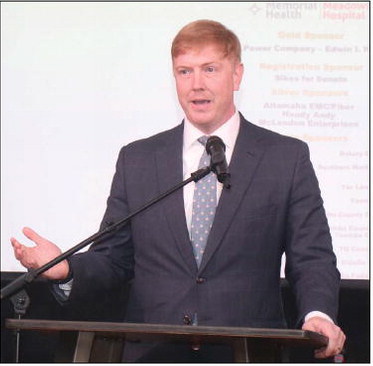
Community members had the opportunity to get a sneak peek at what is expected to come from the current legislative session during the annual Greater Vidalia Chamber Legislative Luncheon, which was held on Thursday, January 8, at the First Baptist Church of Lyons. During the luncheon, State Senator Blake Tillery and State Representative Leesa Hagan discussed their goals and perspectives of the session, with state income tax elimination and rural development efforts at the forefront of their priorities. On Tuesday, January 7, the Senate Study Committee on Eliminating the State Income Tax, which was chaired by Tillery, announced the group’s recommendation for the state legislature to adopt a plan that would end income tax for the first $50,000 that a single citizen made, or the first $100,000 which a married couple made, leaving only additional earnings to be taxed.
During the Legislative Luncheon, Tillery explained that in an effort to help give citizens relief on their taxes, the Senate had turned to income tax, as they do not charge citizens property taxes – that tax is only charged continued from page
by the local school system and city and county governments.
“The income tax is something solely charged by the state – we bring in around $16 billion,” he explained. “We have been working for the past five years to roll the income tax rate down. We were at 6% as a high, [but] we’ve been walking it down year by year. We went to 5.75%. We went to 5.39%. We walked it down to 5.19% where we sit right now. And I expect you’ll see legislation that drops it to 4.99%.”
Tillery compared the income tax decreases to an individual eating a sub sandwich. “When you're walking down that rate from 6 percent to 5 percent rather, 5.75% to 5.39% and now 5.19%, you're eating that subway sandwich from one side. If you want the whole sandwich gone, it doesn't matter what side you eat it from. So what you saw the special study committee that I had the privilege of chairing do is, we said, ‘Why don't we just eat the sandwich from both sides?’” he remarked. “I think that families are hurting. I think they’re trying to pay for groceries. They’re trying to pay for their power bill. They’re trying to pay for childcare, which is as much as their mortgage.”
He continued, as he stated that many individuals had informed him that the price of renting had tripled since 2015, and they were unable to buy a home because they could not afford the down payment. “We know now that the average Georgian is not buying a home until they’re 39 years old,” he added. Tillery said that it was these issues that pushed him to look for ways that the income tax issue could be addressed quickly. He recalled that recently, while on a Zoom virtual conference call from his office in Vidalia, the idea had arisen about exempting the first $50,000 of income of a single individual and the first $100,000 of a married couple from being taxed.
These exemptions would cost the state $3 billion per year. “We realized that our revenue last year had $1.8 billion more than the expenses. Okay, well, that helps – I’m on my way to $3 billion a year, right?” he told the audience. Then, we made a move in last year’s budget. Because we wanted to actually make a prudent budgetary move, we paid for our bonds with cash. That creates $1 billion extra in expenses that we know we are going to have to move back to bonds. So when we move it back to bonds, that creates the second billion dollars that you can apply towards this plan.”
With $2.8 billion already located to make up for the loss, Tillery assured that as the Senate Appropriations Chairman, he could alter the budget to provide the remaining $200,000 needed. “It pays for itself in the first year. There is an additional $3 billion you need in the second fiscal year. How do you pay for that? We have 205 pages of special interest corporate welfare incentives that exist in Georgia today.”
He spoke about some of these incentives that he planned to eliminate through this proposed plan. “If you buy yacht parts — you know all the yachts floating down in Altamaha River – you don't have to pay sales tax in Georgia. You buy parts for your bass boat, you're paying sales tax. How is that fair? It's not. Somebody had a good lobbyist, they got an exemption, and it worked. And we tried it for a few years. Now that we've tried it and that industry's been established, you don't need it anymore. Or at least it shouldn't.”
Tillery continued, “We had a ton of money thrown out on jobs tax credits that are supposed to be reserved for counties that have higher poverty rates like ours. They didn't land in those counties. So if we're going to give the same jobs tax credits to those counties as we are to those counties that we thought we were benefiting with smaller populations, trying to support rural hospitals with higher poverty, I'm ready to comb those back.”
Another area where Tillery explained that he planned on decreasing or revoking the was the sales tax exemption on manufacturing companies’ energy and equipment. “It totals $4.2 billion,” he emphasized. “a tax credit that we passed about six years ago relating to data centers started out at $17 million a year. We said you don't have to pay sales tax if you're buying over $15 million worth of computer parts. Now if you're buying a computer for your child to go to Georgia Southern next semester, you're going to pay sales tax on that. But if you're buying $15 million worth of computers, you don't have to. That sales tax exemption just this year is $700 million.”
“All I'm saying is we've got to get our priorities in line. I'm glad that these businesses are here. I'm not trying to run them out of town. But I can tell you, data centers themselves, with a $238 trillion market cap – they are not making a decision over a $750 million tax credit. They're making decisions over water. They're making decisions over power costs. They're making decisions over land. It is not us,” Tillery said.
Other incentive cuts or reductions that have been reported through the plan include: e credit for em ployer provided child care was enacted in 1994 to help employers help parents enter the workforce. Only about a thousand entities tap it, around a quarter of a percent of all businesses in the state. It is expected to divert $18.2 million from state coffers for the fiscal year that started in July while adding $21.6 million to the economy. Yet the analysis determined that parents who benefit would have worked and accessed child care anyway, resulting in continued from page
zero return on investment.
But the review notes that early child care improves outcomes for children.
(e sales tax exemp tion for personal and laundry services cost the state $176.6 million in the fiscal year that ended in July while adding $249 million to the economy and 7,095 jobs. (e average cost per job was $23,481.
(e PEACH Edu – cation tax credit dates to 2017. It credits taxpay ers who donate to public education. (e credit in creased donations to public education nonprofits by 23% in the fiscal year that ended in July, at a $5 million cost to the state.
(e foster care tax credit was enacted in 2022 to increase donations to organizations that support aging foster children and 'justice-involved' youth.
It is expected to cost $11.1 million in the fiscal year
that started in July.
(e Quali6ed Edu –
cation Expense Tax Cred it, enacted in 2018, cost $88.8 million in the fiscal year that ended in July. It gives taxpayers a dollar-for dollar income tax credit for contributions to private school scholarship funds. '(e credit merely shiffied education expen ditures from public to private schools, with no impact on the state economy,' auditors reported.
(e law enforcement donation tax credit, enact ed in 2022, credits donations to qualified foundations. It cost $12.2 million in the fiscal year that ended in July, increasing such donations 48%.
(e rural hospital tax credit, enacted in 2017, credits donations that help increasingly vulnerable, small rural health care facilities stay afloat. It cost the state $79.5 million in the fiscal year that ended in July, increasing donations 28%.
(e vehicle trade-in
tax exemption cost $129 million in the fiscal year that ended in July and reduced local revenue by nearly $240 million. It saved consumers an average $1,193 per vehicle.
(e manufacturing investment tax credit was enacted in 1994 to stimulate investment in the manufacturing and telecommunications sectors.
It cost $144.2 million in the fiscal year that ended in July 2024, costing an average of $816,477 for each of the 176 jobs it created.
(e sales tax exemp tion for administrative and support services was by far the largest in this group, costing the state $1.2 billion in the fiscal year that ended in July. It resulted in 22,687 jobs at an average cost of $50,196 for each. It added $1.64 billion to the economy.
(e tax exemption for waste management and remediation services cost $79.7 million in the fiscal year that ended in July, resulting in 405 jobs at an average cost of $193,086 for each.
(e data center sales tax exemption, enacted in 2018 to encourage companies to build them in Georgia, exempts a por tion of construction materials and purchases of computers and servers from state and local sales and use taxes. At a cost of $474.2 million in state tax revenue for the fiscal year that ended in July, it was the second largest in this group. ((e study did not quantify the cost of ex emptions from local sales and use taxes.) (e audit said only 30% of data centers chose to locate in the state because of the ex emption, which resulted in 28,350 construction jobs and 5,471 data center operations jobs. (e cost worked out to an average of $15,506 per construction job and $85,414 per operations job.
“If we can calm those credits — $30 billion that exists in code — by just 10%, we can give every single taxpayer and 6ler in Georgia a break,” he emphasized.
He went on to explain that he felt that the state could also allow some tax – es, such as property taxes, to be reduced by allowing states and cities to move towards revenue generated from sales tax. "Our neigh boring states have high- er sales tax. (at's how they're able to pay for part of their income tax. But we didn't have to do it in this plan. We don’t have to cre- ate a new tax — just have to use the cap space we have in the current budget and combat corporate welfare by 10%. And if you've been paying attention to any of your customers, they are screaming for somebody to do that. (ey're asking to be put first.”
He stated that the desire to be put first has been seen throughout the state, especially through the Georgia Public Ser – vice Commission election in November, where the democratic candidates won because of Georgians feeling as though they had not been taken care of by those in the entity.
Tillery also comment ed on his current campaign for the Lieutenant Governor seat, and shared how his absence in the Senate may a-ect the plan.
“I can pay for year one.
I can pay for year two. If the legislature doesn't get serious about corporate welfare credits, you're not going to get to [a complete income tax elimination in] 2032. But I love the idea of putting out credit versus people and making them first because I know where I'm going to side on that one,” he emphasized.
He urged citizens to continue to keep someone within the local area elected to the senate seat, and concluded by thanking the community for their support of him throughout his tenure in office.
State Representative Leesa Hagan also spoke at the event, detailing her goals for rural development in the area, poten- tial property tax changes, and the state’s focus on improving literacy. Her perspective of the current legislative session will be shared in next week's edi tion of The Advance.