


Georgia Power Wins Approval For Massive Expansion
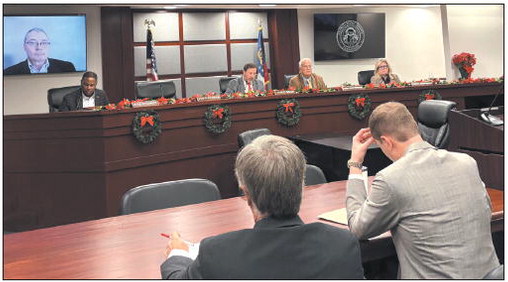
State regulators granted Georgia Power the authority for an historic expansion of its capacity to generate electricity in a unanimous vote Friday. The decision by the five elected members of the Public Service Commission, all Repubcontinued from page
licans, allows the privatelyowned monopoly to build five gas-powered plants and supporting infrastructure while contracting for additional power from other suppliers.
Critics said the expansion, equivalent to five times the power output of the Hoover Dam, could cost up to $60 billion, saddling generations of Georgians with the bill.
The company asked for and got permission to add nearly 10 gigawatts of generating capacity, close to a 50% increase of its capacity. It said its forecasts showed voracious future demand from tech companies that will be building server warehouses to power the internet and artificial intelligence.
In a statement after the vote, Kim Greene, chairman, president and CEO of Georgia Power, called the demand “projected unprecedented growth,” noting that the company had filed customer contracts with the commission this year for three gigawatts in new demand.
Critics contended that the forecast revenue, based on “trade secret” information that the public cannot see, was overly optimistic. If the demand does not materialize, they said, Georgia Power’s other customers would be left with the bill for the construction of that unneeded capacity.
To offset those concerns, the company pledged to shield existing customers from the cost of the expansion but only through 2031. Thereafter, the agreement allows for amendments to hit the brakes if demand does not materialize.
“Large load” customers, such as data centers, will pay for the expansion through the rates they are charged, the company said, but there remains a risk that the data centers do not come.
So Georgia Power addressed that by signing a “stipulated agreement” to allocate costs based on the current revenue forecasts that assume the demand will be there.
This “downward pressure” on rates will equal $8.50 a month for the typical residential customer, the company said.
Lawyers for opponents, including environmental organizations and renewable energy advocates, said there were undisclosed assumptions in Georgia Power’s calculations that they contended could create a countervailing “upward pressure” on residential bills.
They wanted the company to enter its calculations into the public record, so the commission could more easily hold it to account for its pledge in the future.
Lawyers for the Southern Environmental Law Center filed motions calling for the disclosure and for a 30-day delay on the vote.“ The point of this motion is not about whether it’s a good deal or a bad deal,” said Jennifer Whitfield, one of the lawyers. “It’s about … Georgia Power showing its work for the conclusions that are in the agreement so that we can enforce that agreement down the road.”
Her colleague, Bob Sherrier, added later: “We have a problem with the stipulation putting a number on the downward pressure but not a number on the upward pressure.”
Jason Shaw, chairman of the commission, denied the request, saying his agency already had all the necessary information from Georgia Power.
Then the commissioners voted for the expansion, with audience members shouting “shame,” “disgusting” and “sell out!” Before the vote, members of the public got time to speak. Some extolled the benefits of reliable power, saying big companies will not bring jobs to Georgia if the state cannot stay ahead of demand.
“It’s about being proactive rather than reacting too late,” said Susanne Reynolds, director of the Development Authority of Early County in southwest Georgia.
But most were furious about the expansion because of the potential cost for customers and the impact on the environment of burning more fossil fuel.
They also were unhappy with the timing of the vote, less than two weeks before January.
That is when two new commissioners, both Democrats, will take over the seats of the two Republicans they beat decisively in an election last month Julie Jabaley said she would work hard to unseat the remaining three Republicans.
She was among the protesters escorted out of a similar hearing last week after they were told they had violated the commission’s rules on “decorum,” a word that Jabaley mocked.
“If you vote on this proposal today as is you demonstrate an utter lack of respect for thousands of petitioners who have tried to decorously convince you that there’s a better way to fulfill your mission that consumers receive safe and reasonably priced services,” she said.
Jabaley said she wanted “clean, smart energy for the future” and was concerned about the cost of the expansion.
“If you proceed,” she said, “you will absolutely not be decent to the tens of thousands of Georgia Power customers on fixed or low incomes.”